

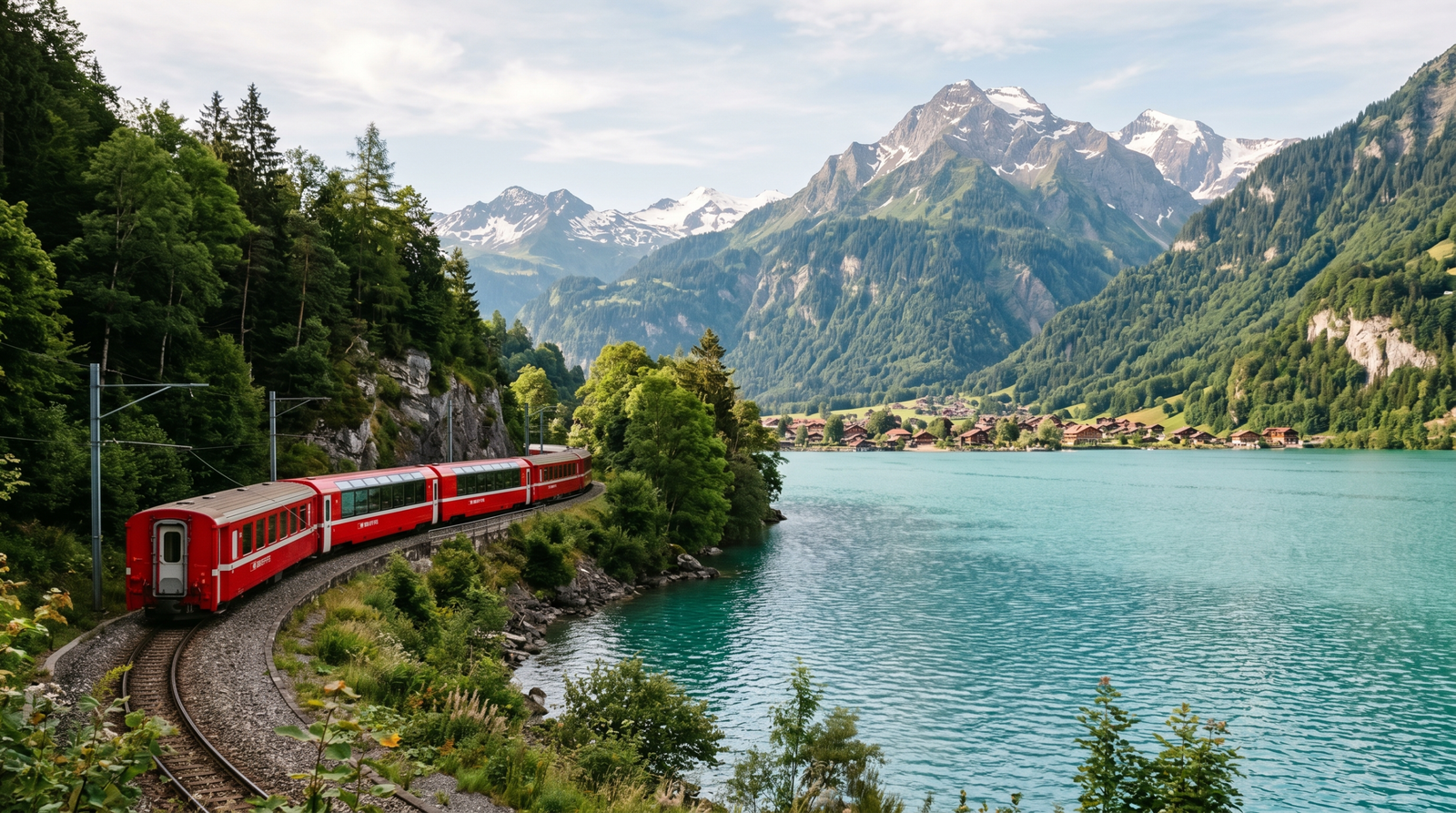

There are train rides that move you from one place to another, and then there are train rides where you stop checking the time. The Luzern Interlaken Express is the second kind. It doesn’t announce itself with engineering spectacle or cliff-edge drama. It does something quieter — it gives you lakes, a mountain pass, half-forgotten villages, and one long, unhurried passage through the middle of Switzerland, and it asks very little of you in return.
I keep coming back to this route because it rewards a specific kind of travel attention. Not the kind that needs peaks or superlatives, but the kind that notices how light moves across water at different hours, or how a valley sounds different once the overnight mist has lifted. This is a train you can take for the first time and already feel, somehow, like you’ve taken it before.
For first-time visitors to Switzerland — particularly those arriving from the UK with a few days and a loose itinerary — the Luzern Interlaken Express is often the thread that makes everything else connect. It links Lucerne’s lake-city elegance to Interlaken’s alpine threshold, covers some of the most visually generous ground in central Europe, and does all of it in under two hours. That is a remarkable ratio.
“The best scenic trains don’t demand your attention. They keep rewarding it.”
What the Route Actually Is — and Why That Matters
The Luzern Interlaken Express runs between Lucerne and Interlaken Ost, operated by Zentralbahn, with hourly departures in both directions throughout the day. The journey takes around 1 hour 50 minutes and crosses some of the most photogenic terrain in central Switzerland: five mountain lakes, the Brünig Pass, a sequence of waterfalls that vary in drama depending on the season, and the kind of alpine countryside that looks like it was arranged specifically for train travel.
It is, technically, a regional connection — a working route, not a heritage attraction. That distinction matters because it explains the atmosphere. Locals use it. Hikers get on at small stations with mud on their boots. Families with tired children take up carriage ends. And woven through all of that is a steady stream of visitors who come specifically for the scenery, trying not to look too conspicuous about it. That mix is exactly why the ride feels lived-in rather than curated.
For a short Switzerland itinerary — Zurich Airport to Lucerne, then Lucerne to Interlaken, then onward to Lauterbrunnen — this train is the spine. It turns a loosely connected set of notable places into something that feels like a coherent journey. And for anyone who has ever stood in a station holding a ticket and wondered whether the route would live up to the photographs: it does. Usually more.
🎫 Swiss Travel Pass — covers the full Luzern Interlaken Express route with no separate ticket needed
Boarding in Lucerne: How the Journey Begins
Lucerne is a good place to begin this kind of trip because the departure feels calm. That sounds like a low bar, but after a few European rail journeys where the chaos starts on the platform, Swiss-calibrated calm is something you actively appreciate. The signs are clear. The platform numbers are accurate. Nobody is running.
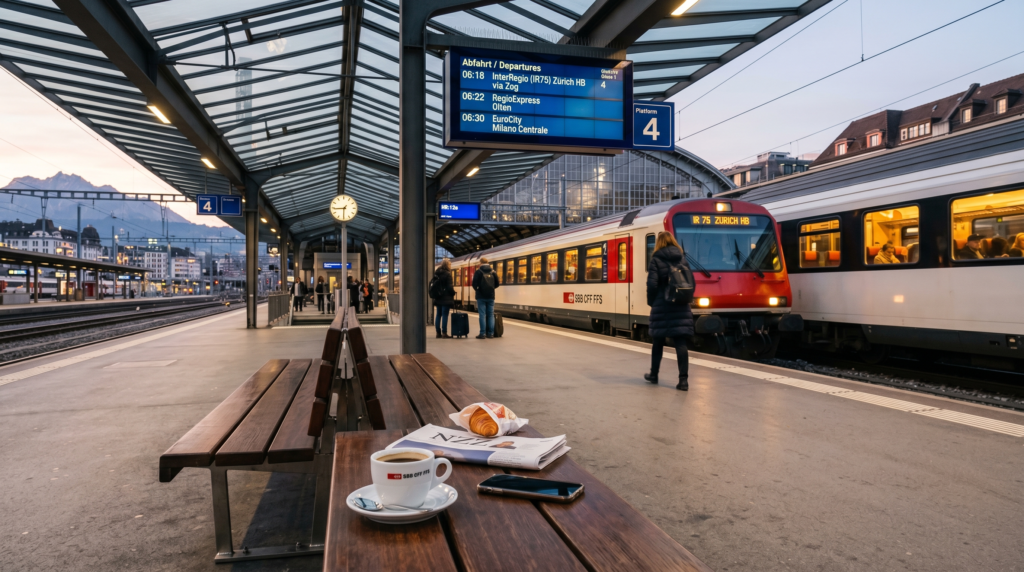
What you notice before the train is the smell — coffee and something warm from the bakery inside the station concourse. I have bought a croissant here more than once and eaten it on the platform while watching the departure board. It sounds minor. It changes the tone of the whole day. You stop feeling like a tourist rushing toward a viewpoint and start feeling like someone who is simply going somewhere by train, in a country where that is always a reasonable thing to do.
The morning platforms at Lucerne have a particular texture to them. A man in a practical coat reading a newspaper. A couple with hiking poles and a spreadsheet-worthy packing list, checking the board twice anyway. Someone in running shoes carrying what appears to be an entire kitchen’s worth of provisions for a two-hour train ride. The domestic scale of Swiss rail travel is one of its underappreciated qualities. It normalises moving through the country, which makes it feel like less of an event and more of a rhythm.
If you can choose your departure time, mornings are better. The light on the lakes is softer before noon, the train is usually less crowded, and you arrive into Interlaken with the whole afternoon available rather than just the early evening. That said, the route does not have a bad departure time. The light on Lake Brienz in late afternoon is its own particular reward.
🏨 Hotels in Lucerne — lakefront, old town and station-adjacent options
What the Journey Actually Feels Like
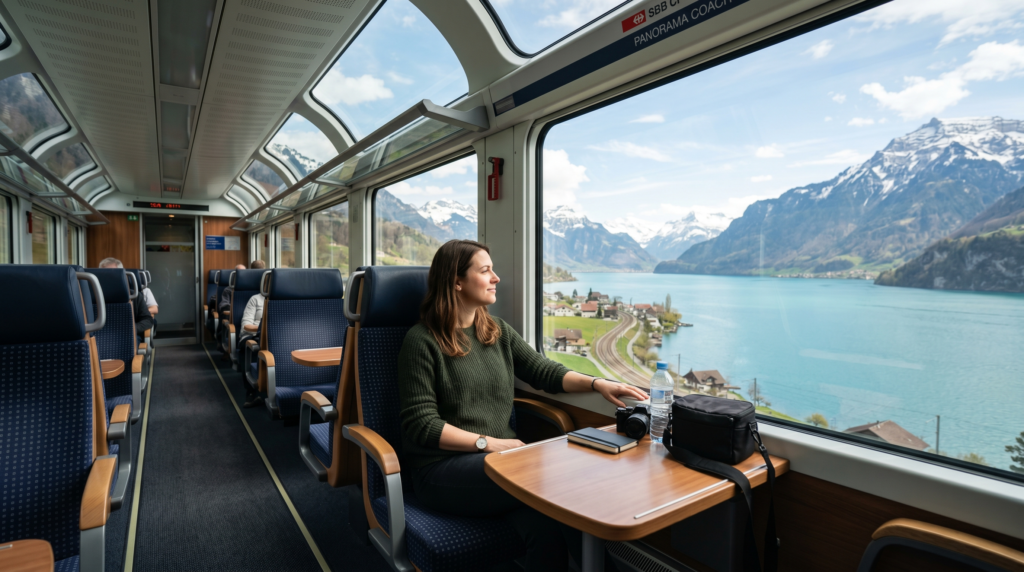
The first thing you notice onboard is the light. The windows are generously sized — wide enough to make the carriage feel almost observatory-like on a clear morning. The landscape is already there before you’ve settled in, framing itself outside your window as though it has been waiting.
People talk softly, or not at all. There is no particular pressure to perform enthusiasm. The scenery manages that on your behalf. What you feel most is the smoothness of it: the gentle curve of the tracks, the carriage settling into a rhythm that feels appropriately slow. You register the bends before you consciously notice them, the way you do on a well-designed road.
The atmosphere is calm but not hushed in a library-enforced sense. It is more like the quiet that settles on long-distance travel when everyone has found their seat and given up on small talk. Some passengers are clearly here for the view — phones out, lenses tilted upward toward the hills. Others are just going to Interlaken and seem mildly surprised by how good the route turns out to be. That particular combination — the deliberate visitor and the unsurprised local — gives the train its character.
What it does not do is deliver constant drama. The Luzern–Interlaken Express is not a succession of gasps. It is a sequence of changes: lake to gorge to meadow to pass to valley, each one folding into the next without announcement. The route rewards looking up every few minutes rather than staring out in one continuous emotional blur. The best moments sneak up on you, which is — honestly — the best thing a scenic train can do.
“Some passengers are clearly here for the view. Others are just going to Interlaken and seem mildly surprised by how good the route turns out to be.”
The Scenic Highlights: What You’ll Actually See
The temptation with a route like this is to list the highlights in order and tick them off. I’ll resist that, partly because the journey doesn’t work that way. Things appear before you’ve been told to look for them. The sequence matters less than the accumulation. But for first-time visitors who want to know what’s coming, here is an honest account.
Lake Lucerne and the Departure
The first stretch out of Lucerne feels like an extended farewell to the city. The lake stays close for a while, and if you spent even one evening on the promenade, there’s a particular satisfaction in watching it from a moving train — you’re leaving somewhere you’ve just started to know. The water shifts between grey and silver depending on the cloud cover, and the city drops away more gradually than you expect, as though it is reluctant to let the route begin.
The Brünig Pass
This is where the landscape changes register. The climb is not dramatic in any headline-grabbing sense — no sheer drops, no vertiginous curves — but it has presence. The villages space out. The slopes draw closer. The air, even through glass, seems to change. There’s a quiet shift in the train’s mood as it crosses the pass, something between anticipation and calm. It’s the moment the journey stops feeling like a lake-country transfer and starts feeling like an approach to the mountains.
Waterfalls
After rain or during snowmelt, the slopes above the train briefly fill with waterfalls. They appear and disappear without ceremony — a flash of white against dark rock, gone before you’ve decided whether to photograph it. They’re not staged like a tourist attraction. They’re just there, part of the working landscape, and all the better for it. In a dry summer they’re fewer and quieter. In May or June after a wet week, they’re everywhere and constant.
Lake Brienz
Most people who have taken this route remember Lake Brienz more clearly than anything else on it. The colour is the thing — that specific blue-green of glacial runoff, the shade that looks too saturated in photographs and is still somehow more intense in person. The train runs close enough to the water that you feel the scale of the landscape rather than just observing it from a safe distance.
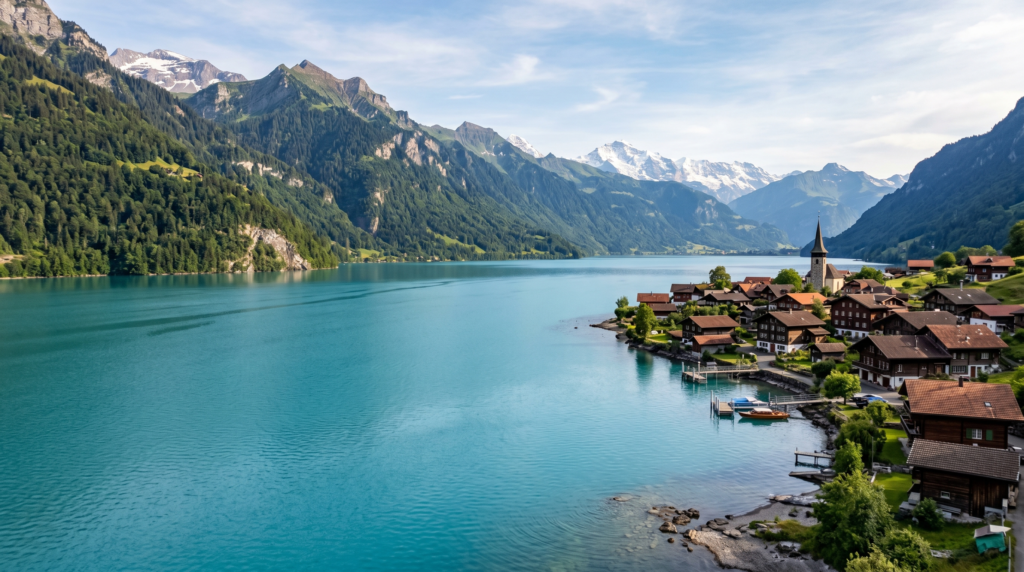
If the sun is out and the water is calm, Lake Brienz is one of those rare places that earns whatever you thought Switzerland was going to look like before you arrived.
The Alpine Villages
Between the lakes and the pass, the route passes through small villages that look as though they have been kept neat as a matter of principle rather than effort. Red roofs, gardens with stakes in the right places, the occasional laundry line. Church spires over the treeline. A name on a platform sign you won’t remember but will recognise if you come back. These are not photogenic set-dressing. They are ordinary places, which is precisely what makes them feel unexpectedly moving at 60km/h.
Where to Sit: An Honest Answer
The seating question is the one everyone searches for before booking, and the honest answer is less satisfying than the internet usually makes it: both sides have good moments, and neither side guarantees a perfect journey.
Which Side of the Train?
The views on the Luzern–Interlaken Express are genuinely bilateral — you’re not locked onto the “wrong” side in the way some routes punish poor seat choices. That said, on the stretch approaching Lake Brienz and running alongside it toward Interlaken, the water feels closer and more present from the right side when travelling from Lucerne. The Brünig Pass climb offers good views in both directions, and the departure stretch through Lucerne’s lake country is equally rewarding from either side.
If forced to choose: right side from Lucerne, left side from Interlaken. But honestly — a window seat matters far more than which window.
First Class or Second Class?
First class is nicer. I would not oversell it. The difference is more space, a slightly calmer atmosphere, and on busier departures a better chance of sitting without someone’s bag in your peripheral vision. It is not a materially different train experience — the windows are the same size, the views are identical, and the journey takes the same amount of time either way.
For photographers or anyone who wants to spend the ride writing, reading, or simply being present without a degree of elbow negotiation, first class can feel worth the premium. For everyone else, second class is absolutely adequate. The scenery is the real premium product here, and that doesn’t come with a class surcharge.
Reservations
The route runs hourly, which creates a false sense of security. In summer and on popular weekend departures, the train fills up more than you’d expect, and specific window seats can go early. The reservation fee is modest. Pay it.
It’s one of those details that separates people who have a lovely morning from people who spend forty-five minutes of their scenic rail highlight standing in the corridor between carriages.
🚂 Book the Luzern–Interlaken Express — with seat reservation included
Arriving into Interlaken
Lucerne feels like a city that has settled into itself over centuries. Interlaken feels like a threshold.
It announces itself differently. The surrounding peaks are closer, the valley narrower, the sky arranged in a way that makes you feel you’ve moved into a different chapter of the same story. The station is functional and a little unremarkable — which is, in hindsight, the right architecture for a gateway. It doesn’t compete with what’s outside it.
If you are continuing to Lauterbrunnen, this is where the trip opens further. The connection is straightforward: a short walk across to the regional platform, a direct train, around 20 minutes. The Swiss railway system handles it with the kind of casual efficiency that makes other countries’ rail transfers feel like an ordeal. You step off one train, move without fuss, and board another. The valley begins before you’ve worked out whether you needed the toilet.
What you carry out of Interlaken Ost is the sense that the mountain part of the trip has properly begun. Lucerne was the opener, the train was the movement, and here — with the Bernese Oberland gathering around you — is where the tone of the whole journey changes.
🏨 Hotels in Interlaken — close to Interlaken Ost for easy valley connections
Swiss Travel Pass: What’s Covered, What Isn’t
The Luzern–Interlaken Express is fully covered by the Swiss Travel Pass and Swiss Travel Pass Flex, which is one of the main reasons it slots so cleanly into a short first-visit itinerary. You board without a separate ticket purchase, which matters more than it sounds when you are navigating an unfamiliar station on the second morning of a trip, still unsure where the platform numbers are displayed.
What the pass doesn’t automatically provide is a seat reservation. Coverage and reservation are two different things on Swiss scenic trains, and this is the detail that catches people out. The pass lets you board; it doesn’t guarantee a specific window seat on a busy summer Saturday. Reserve separately and separately early.
The broader usefulness of the pass on this route is worth naming clearly. A single Swiss Travel Pass can cover: the direct train from Zurich Airport to Lucerne, the Luzern–Interlaken Express itself, the regional hop from Interlaken Ost into Lauterbrunnen, local city transport in Lucerne and Interlaken, and a boat ride on Lake Lucerne if the itinerary includes one. For a 3-day rail-focused trip, the pass removes every individual ticketing decision from the journey. That is not nothing.
🎫 Swiss Travel Pass — covers this route and every connection in a 3-day Swiss itinerary
“A pass is not the same as a reservation. Coverage means you can board. A reservation means you get the window.”
Is First Class Worth It?
Probably not for most people. Possibly yes for some specific ones.
The honest description of first class on the Luzern–Interlaken Express is: more space, a calmer environment, and a marginally higher chance that the seat next to you will be empty. It is not a lounge car. There is no table service or particular atmosphere of luxury. The views are identical. The journey takes the same time. The train is the same train.
Where first class earns its cost: travelling in peak summer season when second class gets genuinely crowded; wanting uninterrupted window time for photography or writing; caring about elbow room for two hours. Where it doesn’t: off-peak travel, budget-conscious trips, families who won’t be sitting quietly regardless.
My honest default: if you are already spending on the Swiss Travel Pass and mid-range hotels, the first-class supplement is relatively small and the comfort uplift is real. If you are watching the budget carefully, second class is not a compromise you’ll regret.
Common Mistakes Worth Knowing About
The most common one is treating the train as a box to tick rather than an experience to have. People arrive with phones already recording, spend the first twenty minutes photographing everything in sight, then have eighty minutes of footage they’ll never watch and a memory that feels somehow thinner than it should. A few photographs are enough. The best memory is usually not the image — it’s the light in the carriage and the particular silence around it.
The second mistake is overloading the day. The Luzern–Interlaken Express is beautiful, but it’s also a transport connection. If you’ve scheduled three fixed stops around it and a pre-booked activity in Interlaken at a specific time, you will spend the journey anxious instead of present. Keep the day loose enough for the train to be the main event, not the logistics thread between events.
Reservations are the third gap. The route runs hourly, which makes people complacent. That works fine until July or August, when suddenly your ideal window seat has disappeared and you’re standing in the connection between carriages watching Lake Brienz through someone else’s shoulder. Reserve ahead in busy months. It costs very little and fixes the problem entirely.
Where to Stay: Lucerne, Interlaken, and Lauterbrunnen
The three bases that make most sense for this itinerary have different personalities, and it’s worth being honest about what each one actually delivers.
Lucerne
Lucerne rewards travellers who want a graceful start. The station-adjacent area is practical for early morning departures. The lakefront is more cinematic — quieter after 9pm, better light from the window in the morning. If this is your first night in Switzerland and you want the arrival to feel properly atmospheric, the lakefront wins.
Interlaken
Functional and useful. Not the most romantic base in Switzerland, and it doesn’t pretend to be. What it offers is proximity to everything: the station, the restaurants, the bus connections, the quick train to Lauterbrunnen. Choose Interlaken Ost over Interlaken West if Lauterbrunnen is on your itinerary — the Ost-side position keeps the transfer clean.
Lauterbrunnen
Stay here if you want the trip to feel immersive rather than efficient. The valley has a slower, quieter register than Interlaken. Evening there feels genuinely different — fewer crowds, closer cliffs, waterfalls that sound louder after dark. It is the place that people remember longest when the trip is over, often more than any viewpoint or summit. If your schedule allows one night in the valley, take it.
🏨Compare hotels across Lauterbrunnen
📱 eSIM for Switzerland — mobile data active from landing, no roaming charges
FAQ: The Luzern–Interlaken Express
How long is the Luzern–Interlaken Express journey?
About 1 hour 50 minutes between Lucerne and Interlaken Ost. Departures run hourly in both directions throughout the day, which makes it one of the most flexible scenic routes in Switzerland for building a short itinerary around.
Is the Luzern–Interlaken Express a panoramic or scenic train?
It runs panoramic-style carriages with large windows and is widely regarded as one of Switzerland’s best scenic rail experiences. It is not a dedicated tourist train — it’s a working hourly service — which is part of what makes it feel more interesting than a heritage attraction.
Is it covered by the Swiss Travel Pass?
Yes, fully. The rail fare is included in the Swiss Travel Pass and Swiss Travel Pass Flex. You still need a separate seat reservation in busy periods, but the journey itself requires no additional ticket.
Do I need to reserve a seat?
Not required, but recommended in summer and on weekends. The train runs hourly, so there’s flexibility, but specific window seats on popular departures fill up. The reservation fee is small. Do it early.
Which side of the train has the best views?
Both sides have good moments across the full route. If you want to maximise Lake Brienz exposure travelling from Lucerne, the right side gives you more water time. The Brünig Pass is rewarding from either. A window seat matters more than which window.
Is first class worth it on this route?
For most travellers, no. The views are identical in both classes. First class offers more space and a calmer atmosphere, which is useful in peak season or if you want to photograph or write undisturbed. Off-peak, second class is perfectly comfortable.
How do I get from Interlaken to Lauterbrunnen after arriving?
Direct regional train from Interlaken Ost, typically around 20 minutes. The connection is simple and covered by the Swiss Travel Pass. No taxi, no advance booking — just walk across the platform.
What is the best time of year to take this route?
Late May to June and September to October for clearest mountain views, softer light, and moderate crowds. July and August are the busiest and hottest. Winter is atmospheric but best suited to a ski-focused trip rather than a scenic rail one.
A Final Thought on Why This Route Works
What makes the Luzern–Interlaken Express worth it is not only the scenery — though the scenery is superb. It’s the way the journey feels proportioned to Switzerland itself: efficient, calm, and quietly generous.
You don’t get the sense that the country is trying to impress you. The route simply is what it is: tidy, high-functioning, and unexpectedly moving once it has you in a window seat and the lakes start appearing. By the time you reach Interlaken, you’ve crossed the Brünig Pass, watched waterfalls appear and dissolve against dark rock, and felt the Bernese Oberland begin to gather around you. That is a remarkable amount to carry in under two hours.
For first-time visitors, particularly those arriving from the UK with a short window and a loose plan, this is often the moment Switzerland stops feeling like a place on a list and starts feeling like a country you want to understand better. The train does not complete the trip. It sets the tone for the rest of it.
Come back on a morning when the mist is still in the valley. Sit by the window. Don’t photograph everything. The light will do more of the work than you expect.
“By the time you reach Interlaken, you’ve already carried a lake, a mountain pass, and a dozen waterfalls through a country that seems quietly pleased you noticed.”
Plan Your Switzerland by Train Journey
- 🎫 Swiss Travel Pass — covers this route and all connections
- 🚂 Book the Luzern–Interlaken Express — with seat reservation
- 🏨 Hotels in Lucerne — lakefront and station options
- 🏨 Hotels in Interlaken — close to Interlaken Ost
- 🏨 Hotels in Lauterbrunnen — valley-floor, book early in summer
- 📱 Switzerland eSIM — data on from landing, no surprises
Related Articles on BotlyTravel
- 3 Days in Switzerland by Train: Zurich Airport to Lucerne, Interlaken and Lauterbrunnen
- Best Swiss Travel Pass Options for First-Time Visitors (2025 Guide)
- Interlaken vs Lauterbrunnen: Where Should You Stay?
- The Glacier Express vs the Luzern–Interlaken Express: Which Scenic Train to Book?
- Best Day Trips from Lucerne by Train
- Switzerland Travel Budget Guide for UK Visitors