


Heads up: some links in this guide are affiliate links. If you book a hotel, tour or eSIM through them, I earn a small commission — at no extra cost to you. It helps keep BotlyTravel running, and I only ever link to things I’d actually recommend.
I live and work on Bulgaria’s Black Sea coast, and every summer I meet hundreds of British holidaymakers who tell me the same thing: “I had no idea Bulgaria was like this.” They come for a cheap beach week and discover a country with ten UNESCO World Heritage sites, proper ski resorts, Roman amphitheatres still in use, and dinner bills that make them laugh out loud.
Bulgaria is one of the few places in Europe where you can ski in the morning and reach the seaside the same evening. It works for families on package holidays, couples after quiet old towns, solo travellers on a budget, and digital nomads who have quietly turned Bansko into one of Europe’s remote-work hubs.
This guide covers everything I’d tell a friend planning their first trip: where to go, what it costs, how to get around, and where the tourist traps are. It’s long, so use the headings to jump to what you need.
Quick practical note for 2026: Bulgaria now uses the euro (since 1 January 2026) and is a full Schengen member, so there are no border checks if you’re arriving from another Schengen country. Two things that used to confuse visitors, both gone.
Planning your trip? Check current hotel prices in Bulgaria — prices on the coast and in the ski resorts move fast, and the best-value places sell out months ahead.
Why Visit Bulgaria?
It’s genuinely affordable. Not “affordable for Europe” with an asterisk. A three-course dinner with wine for two often costs €30–40 outside the resort strips. A week’s ski pass in Bansko costs roughly what three days cost in the Alps. Hotels, taxis, museum tickets — most things run 30–50% below Spain or Italy.
It’s safe. Bulgaria is a low-crime destination by European standards. The main things to watch are the same as anywhere: overcharging taxis, drink prices in nightlife zones, and aggressive driving on the roads. I cover the specifics in the FAQ.
The weather does everything. The climate is continental inland and milder on the coast. That means hot, reliable beach summers (June–September), snowy mountain winters (December–April), and gorgeous shoulder seasons for cities and hiking.
The history runs deep. Thracian tombs, Roman cities, medieval Orthodox monasteries, Ottoman bridges, and whole towns preserved from the 19th-century National Revival. Bulgaria has 10 UNESCO World Heritage sites, which is remarkable for a country this size.
The food is underrated. Shopska salad with proper tomatoes, banitsa straight from the bakery, slow-cooked kavarma, grilled kebapche, and tarator (cold cucumber and yoghurt soup) on a 35°C day. Wash it down with local wine or — carefully — rakia.
The nature is wild. Pirin and Rila are serious mountain ranges with marked trails, glacial lakes and huts. The coast has long sandy beaches. Inland you’ll find rock formations, gorges and caves that barely see foreign visitors.
Best Places to Visit in Bulgaria
Sofia
Bulgaria’s capital is where most international flights land, and it deserves more than a night in transit. The centre is compact: the gold-domed Alexander Nevsky Cathedral, the 4th-century St George Rotunda hidden in a government courtyard, Roman ruins under the metro station, and the long yellow-brick boulevard of Tsar Osvoboditel. The café and restaurant scene has improved enormously in the last decade.
Sofia’s trump card is Vitosha Mountain, which rises straight from the southern suburbs. Locals hike it on summer weekends and ski it in winter.
- Why visit: layered history, good food, cheapest capital-city break in the EU
- Best attractions: Alexander Nevsky Cathedral, Boyana Church (UNESCO), National History Museum, Vitosha Boulevard, free walking tours
- Best time: April–June and September–October
- Where to stay: around Vitosha Boulevard or the Oborishte district for walkability
Where I’d book: a boutique hotel near Vitosha Boulevard puts everything within 15 minutes on foot. Compare Sofia hotels here. For day trips, Rila Monastery tours from Sofia sell out in summer — book ahead.
Plovdiv
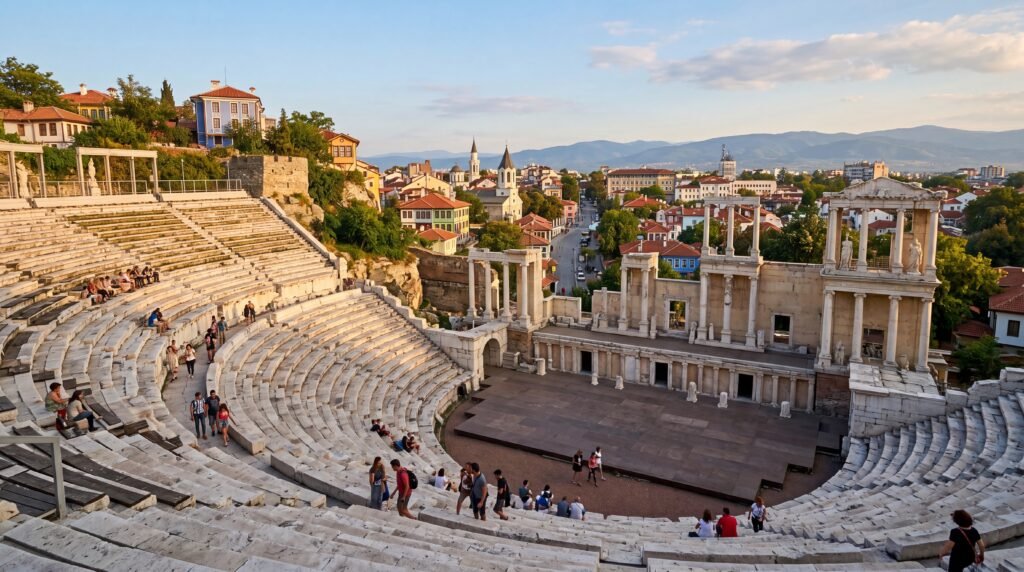
Plovdiv is older than Rome and feels like it. The Old Town is a hill of cobbled lanes and painted Revival-era mansions, and the Roman Theatre built into the hillside still hosts concerts on summer evenings — seeing a show there is one of the best things you can do in Bulgaria. Below it, the Kapana (“the Trap”) district is all small bars, galleries and street food.
Plovdiv was European Capital of Culture in 2019 and the confidence stuck.
- Why visit: the best old town in Bulgaria, Roman heritage you can actually sit in
- Best attractions: Roman Theatre, Old Town houses, Kapana district, Roman Stadium under the main street
- Best time: May–June, September; summer works but it’s the hottest city in Bulgaria
- Where to stay: in or just below the Old Town, or in Kapana if you like nightlife on your doorstep
Check Plovdiv hotel prices — Old Town guesthouses are small and book up around festival dates.
Veliko Tarnovo
The medieval capital of Bulgaria, stacked dramatically above a loop of the Yantra River. The headline act is Tsarevets Fortress, the restored hilltop citadel of the Bulgarian tsars; in summer there’s an evening sound-and-light show that lights up the whole hill. Wander Samovodska Charshia, the old craftsmen’s street, and eat dinner on a terrace hanging over the gorge.
- Why visit: the most dramatic setting of any Bulgarian town, medieval history
- Best attractions: Tsarevets Fortress, Samovodska Charshia, nearby Arbanasi village
- Best time: April–October
- Where to stay: Gurko Street or anywhere in the old town with a river view
Find a guesthouse with a gorge view — they cost barely more than the ones without.
Rila Monastery
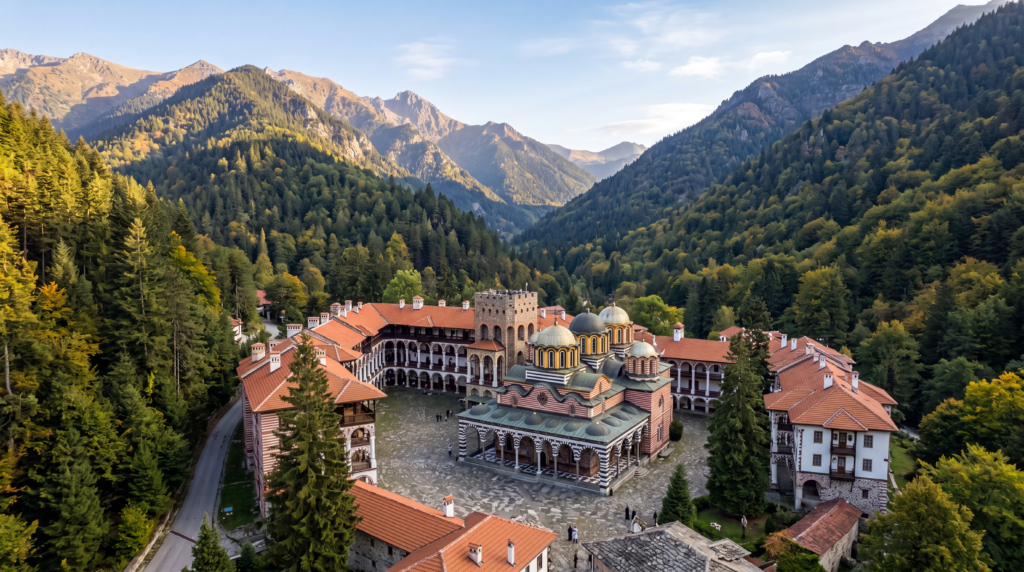
Bulgaria’s most important monastery and a UNESCO site, founded in the 10th century and rebuilt in the 19th, sits deep in the Rila Mountains about two hours south of Sofia. The striped arcades, painted frescoes and mountain backdrop make it the single most photographed place in the country. Go early or stay nearby overnight — by 11am in summer the courtyard fills with coach groups.
Try the fried doughnuts (mekitsi) with honey from the stalls just outside the gate. Everyone does, and they’re right to.
- Why visit: the defining image of Bulgarian Orthodoxy, mountain scenery
- Best time: May–October; magical with snow if roads are clear
- Where to stay: most visit as a Sofia day trip; the monastery itself rents simple rooms if you want the courtyard to yourself at dawn
Day tours from Sofia usually combine Rila Monastery with Boyana Church — an efficient way to tick off two UNESCO sites without hiring a car.
Seven Rila Lakes
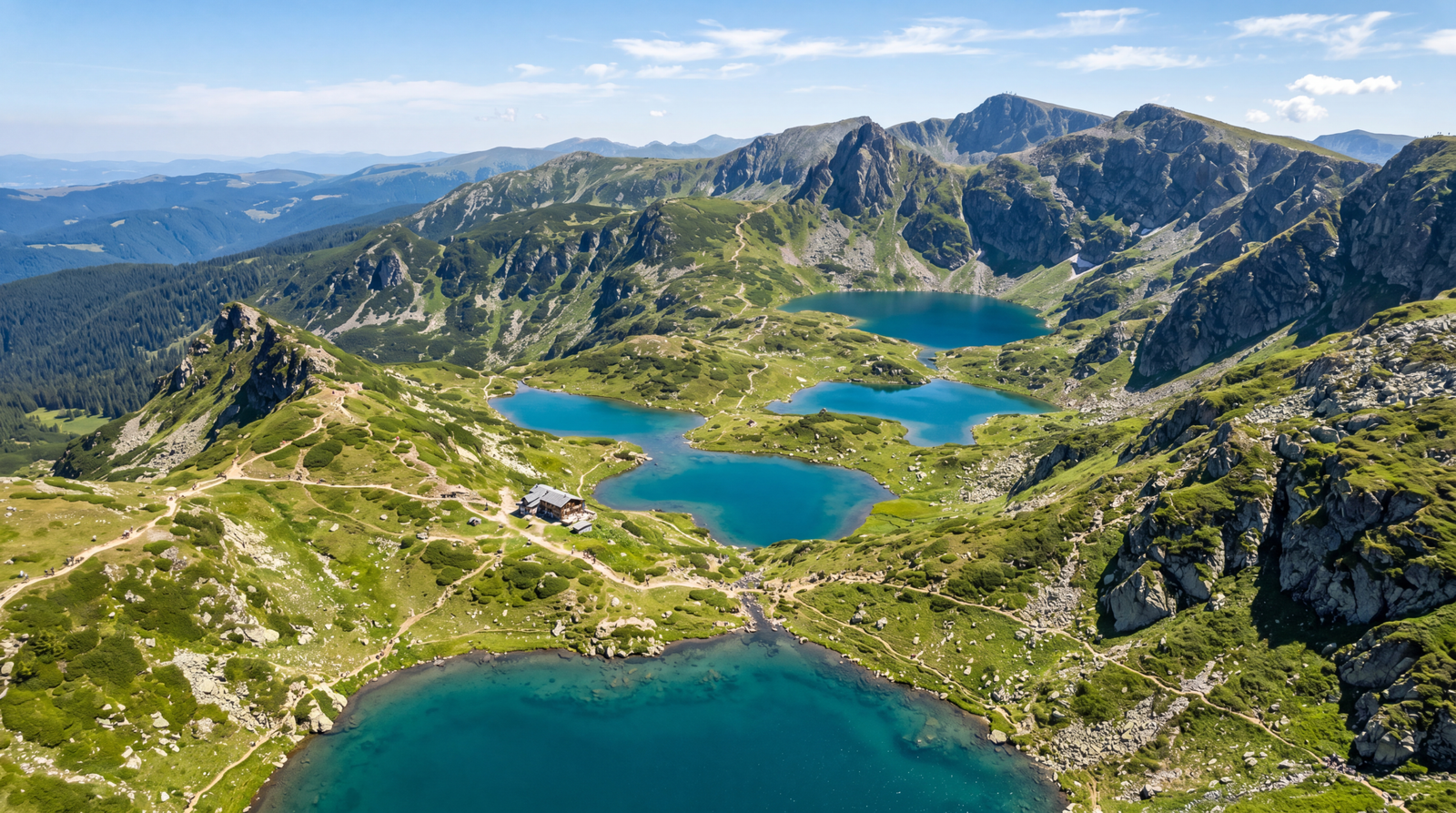
A chain of seven glacial lakes strung between 2,100 and 2,500 metres in the Rila range, connected by a well-trodden hiking loop. A chairlift from the Pionerska hut does the hard climbing; from the top station the full circuit of the lakes takes four to five hours at a relaxed pace. On clear days the view from the upper ridge, with all seven lakes below you, is the best in Bulgaria.
- Why visit: the country’s most famous hike, achievable for anyone reasonably fit
- Best time: late June to September; snow lingers into June
- Practical: start early, take layers and water — mountain weather turns fast
- Where to stay: Sapareva Banya below the lift has hot mineral springs, which your legs will thank you for
Belogradchik Rocks
In the far northwest, weird red sandstone towers rise out of the forest, with a fortress built directly into the rocks. It’s one of the most striking landscapes in the Balkans and almost nobody goes, because it’s three hours from Sofia and not on the way to anywhere. That’s exactly why it’s worth it. Combine with the Magura Cave and its prehistoric paintings nearby.
- Why visit: the strangest scenery in Bulgaria, no crowds
- Best time: April–October
- Where to stay: a night in Belogradchik town; this isn’t a day trip
Melnik
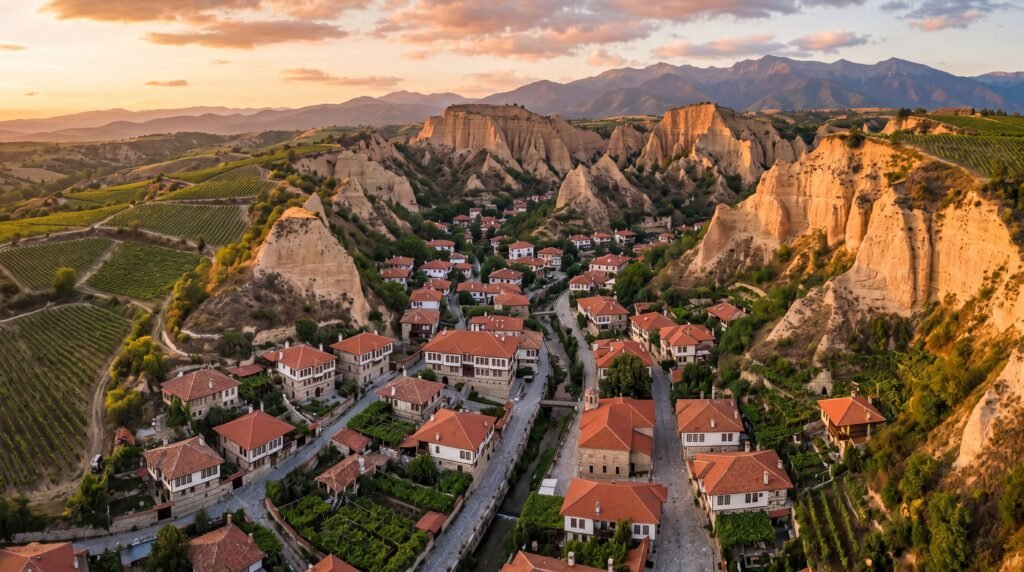
Officially Bulgaria’s smallest town, tucked under sand pyramids near the Greek border, and the heart of the country’s oldest wine region. The local Shiroka Melnishka grape makes dense reds that Churchill reportedly ordered by the barrel. Visit a few family wineries, walk up to Rozhen Monastery, and stay the night — Melnik empties beautifully after the day-trippers leave.
- Why visit: wine, sand pyramids, old stone houses
- Best time: spring and autumn; September for harvest season
- Where to stay: a family-run mehana (tavern-guesthouse) in town
Doing the south of Bulgaria properly — Melnik, Rila, Pirin — is where hiring a car genuinely pays off. Buses exist but eat your day.
Bulgaria’s Black Sea Coast
This is my patch — I work the coast every summer season — so let me be honest about it. The Bulgarian Black Sea coast is 380 kilometres of mostly sandy beaches, warm shallow water, and resorts ranging from full-throttle party strips to fishing towns where the loudest thing at night is the sea. Pick the right base and you’ll love it. Pick the wrong one and you’ll wonder what the fuss is about.
The two gateways are Burgas Airport for the southern coast (Sunny Beach, Nessebar, Sozopol) and Varna Airport for the north (Golden Sands, Albena, Balchik).
Sunny Beach
Bulgaria’s biggest resort: an 8-kilometre sweep of sand backed by hundreds of hotels, water parks, and a nightlife strip that runs until sunrise. It’s loud, cheap and unapologetic, and in July and August it’s heaving. It also has some of the best-organised beaches in the country, with watersports, family zones and a long promenade.
My honest advice: Sunny Beach is brilliant if you know what you’re booking. Families do best at the northern end near the Cacao Beach side or in the quieter hotel complexes; the central strip belongs to the 18–30 crowd after dark.
- Who it suits: party groups, families on all-inclusive packages, anyone wanting maximum beach for minimum money
- Best beaches: the central sweep for facilities, the northern end for space
- Don’t miss: a boat trip along the coast, the water parks, and the 20-minute walk (or tourist train) to Nessebar
I’ve written a full guide to Sunny Beach holidays and a separate list of the best things to do in Sunny Beach, including the boat trips worth your money — some are excellent, some are floating bars with a markup.
Compare Sunny Beach hotels — all-inclusive deals booked by February are routinely 30–40% cheaper than June prices.
Nessebar
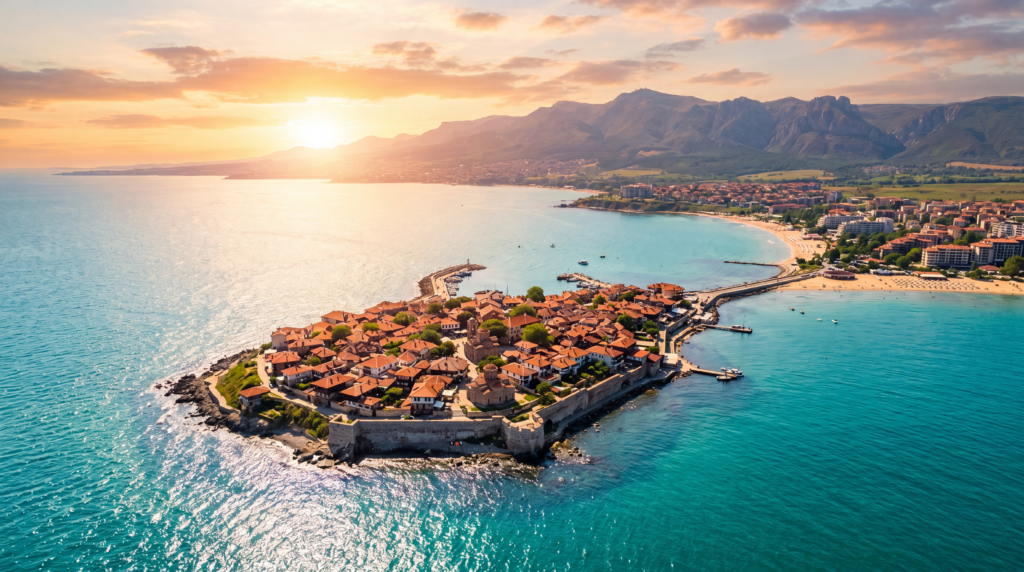
A UNESCO World Heritage old town on a rocky peninsula joined to the mainland by a narrow causeway, three kilometres from Sunny Beach. Inside the walls: Byzantine church ruins, wooden Revival houses leaning over cobbled lanes, and views back across the bay. Nessebar was Bulgaria’s busiest tourist municipality in 2025, with close to 1.5 million visitors, and on August afternoons it shows. Come before 10am or after 6pm and you get the town the way it deserves to be seen.
The newer part of Nessebar, on the mainland, has good beaches and a calmer, more local feel than Sunny Beach — it’s where I’d put a family that wants beach plus culture.
- Who it suits: couples, families, anyone who wants history with their beach
- Best attractions: the old town churches, the windmill on the causeway, South Beach
- Don’t miss: Aqua Paradise, the big aquapark — I’ve reviewed it honestly, queues and all
Full guide here: best things to do in Nessebar Old Town.
Check Nessebar hotels — staying inside the old town is atmospheric but pricier; new town beachfront is the value play.
Burgas
The southern coast’s working city, and badly underrated. Burgas has a long city beach, the lovely Sea Garden park running along the front, a walkable centre, and real restaurants at real prices. It’s also the logistics hub: the airport, the bus and train stations, and day trips to Sozopol, Nessebar and the inland Strandzha hills all run through here.
- Who it suits: independent travellers, anyone allergic to resort culture
- Best attractions: Sea Garden, the salt lakes and their flamingos (yes, flamingos), Aquae Calidae Roman baths
- Best beaches: the city beach is fine; Kraimorie and the dunes south of town are better
Sozopol
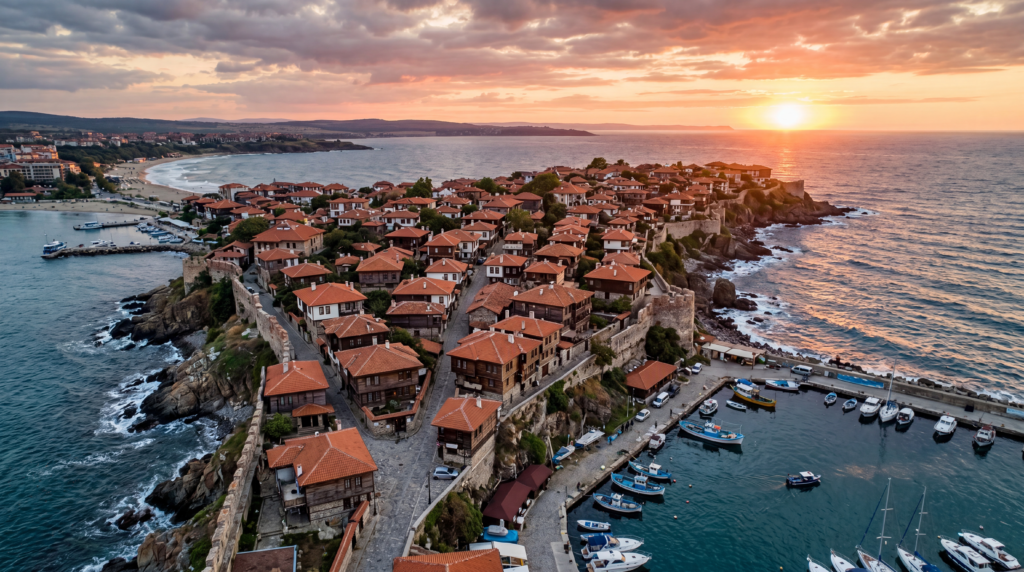
The southern coast’s answer to Nessebar: an old fishing town on a peninsula, with wooden houses, art galleries and two proper sandy beaches right in town. Sozopol skews more Bulgarian and arty where Nessebar skews international, and its September Apollonia arts festival is the best time on the whole coast in my opinion — warm sea, no crowds, music everywhere.
- Who it suits: couples, culture-first travellers, September people
- Best beaches: Harmanite in town; Kavatsite and Smokinya camping beaches just south
- Where to stay: old town for romance, Harmanite for beach convenience
Varna
Bulgaria’s third city and the capital of the northern coast. Varna has urban energy the resorts lack: the Archaeological Museum holds the oldest worked gold in the world (6,000+ years old), the Roman baths are right in the centre, and the Sea Garden park stretches for kilometres along the city beach. Good flight connections make it a practical base.
- Who it suits: city-break-plus-beach travellers, nightlife without the resort strip
- Best attractions: Archaeological Museum, Roman Thermae, Sea Garden, day trip to the Stone Forest (Pobiti Kamani)
- Best beaches: city beaches are decent; better sand starts at the resorts north of town
Golden Sands
The northern coast’s big resort: a genuinely beautiful wide beach backed by forested hills, with a more compact and slightly more upmarket feel than Sunny Beach. Nearby Albena is the family specialist, and the white town of Balchik with its botanical garden and Romanian queen’s palace makes the best day trip on the northern coast. Push on to Cape Kaliakra for cliffs and dolphins if you have a car.
- Who it suits: beach-first holidays with a bit more polish; German and Romanian crowds rather than British
- Best beaches: the main strip is the draw; Kranevo south of the resort is quieter
Heading to the coast? Compare hotels across all the Black Sea resorts and read my Sunny Beach guide before you choose a base — the resorts are far more different from each other than the brochures suggest.
Bulgaria’s Best Ski Resorts
Here’s the thing British skiers are slowly working out: Bulgaria is the best-value lift-served skiing in Europe. The terrain won’t rival the Trois Vallées, but for beginners, intermediates and families, the maths is hard to argue with — a week here, including lessons and rental, often costs less than the lift pass alone in a top French resort.
Three resorts matter: Bansko, Borovets and Pamporovo.
Bansko
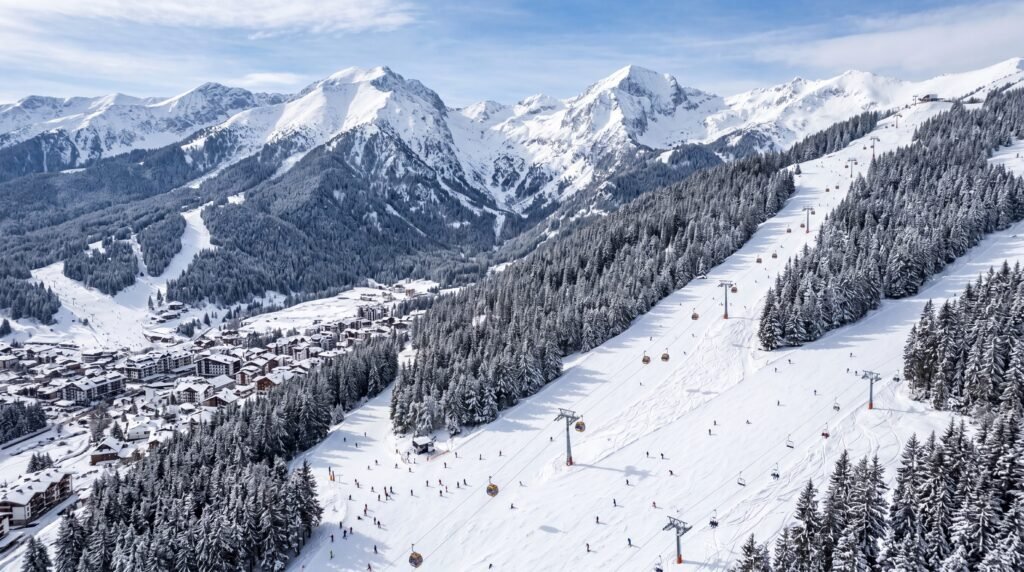
The flagship. Bansko sits under Todorka peak in the Pirin Mountains (a UNESCO national park), with around 75km of pistes between roughly 990m and 2,600m. A single gondola connects the old town to the ski area, which is Bansko’s one famous flaw: in peak weeks the morning gondola queue can hit 30–45 minutes. Locals beat it by going up early or taking the shuttle to the mid-station.
The skiing is the most varied in Bulgaria — long tree-lined reds, a proper black under the Todorka chair, decent beginner zones up the mountain, and the best snowmaking in the country, which keeps the season running from mid-December to mid-April.
What makes Bansko special is the town itself. The old quarter is full of mehanas (traditional taverns) with open fires, grilled meat and live folk music, and après ranges from quiet wine bars to full party venues. It’s also become a year-round town: summer hiking in Pirin, and one of Europe’s biggest digital-nomad communities thanks to cheap living and fast internet. The resort drew over 360,000 visitors across 2023, and it keeps growing.
- Ski terrain: ~75km, the most varied in Bulgaria; best for confident beginners to advanced intermediates
- Lifts: one access gondola plus a modern chair network on the mountain
- Families: good ski schools with English-speaking instructors; kids’ parks at Bunderitsa
- Summer: hiking, mountain biking, and the lowest hotel prices of the year
- Getting there: ~2 hours’ transfer from Sofia Airport
Compare Bansko hotels — places within walking distance of the gondola charge a premium that’s worth paying in February half-term week.
Borovets
Bulgaria’s oldest resort (the royal family hunted here from 1896) and the closest to Sofia — about 75 minutes from the airport, which makes it the easiest ski weekend in Europe from the UK. Around 58km of pistes spread across three zones on the slopes of Musala, the highest peak in the Balkans.
Borovets is the beginner and family specialist. The nursery slopes sit right by the hotels, the ski schools are well drilled in teaching absolute beginners, and the Markudjik zone up high keeps its snow late. Confident skiers will exhaust the map in three or four days, which is the honest trade-off. Night skiing on the floodlit front pistes is a highlight.
The resort itself is purpose-built rather than a real town — a cluster of hotels, bars and rental shops in the forest. Nightlife is lively in a cheerful, unpretentious way.
- Ski terrain: ~58km; ideal for beginners and early intermediates
- Lifts: gondola to Yastrebets plus chairs and drags
- Families: the strongest package in Bulgaria — short transfer, doorstep nursery slopes
- Summer: hiking to Musala peak, downhill biking
- Getting there: ~1h15 from Sofia Airport
Check Borovets hotel deals — the big hotels by the gondola sell ski-pack bundles (pass + rental + lessons) that beat buying separately.
Pamporovo
The southern option, deep in the Rhodope Mountains, and famous as Bulgaria’s sunniest ski resort — the locals claim 240 sunny days a year. Around 37km of gentle, forest-lined pistes below the Snezhanka TV tower. The skiing is the easiest of the three resorts, which is precisely the appeal: wide, confidence-building runs, mild weather, and a relaxed pace that suits families with small children and nervous first-timers.
Pamporovo links with neighbouring Mechi Chal (Chepelare) for a bit more variety. The Rhodopes themselves are gorgeous — if you have a rest day, the village of Shiroka Laka and the Trigrad Gorge are nearby.
- Ski terrain: ~37km; the best mountain in Bulgaria to learn on
- Families: excellent; gentle terrain and patient instructors
- Summer: Rhodope hiking, the quietest and greenest of the three
- Getting there: ~3h from Sofia, ~1h45 from Plovdiv
Compare Pamporovo hotels — half-board deals here are some of the cheapest ski accommodation in Europe.
Bansko vs Borovets vs Pamporovo
| Bansko | Borovets | Pamporovo | |
|---|---|---|---|
| Pistes | ~75km | ~58km | ~37km (more with Mechi Chal) |
| Best for beginners | Good | Very good | Best |
| Best for families | Good | Best (short transfer, doorstep slopes) | Excellent for young kids |
| Best for intermediates+ | Best | Decent | Limited |
| Best nightlife | Best (real town, mehanas, bars) | Lively, compact | Quiet |
| Best value | Mid (priciest of the three) | Good | Best |
| Closest airport | Sofia ~2h | Sofia ~1h15 | Plovdiv ~1h45 / Sofia ~3h |
| Longest season | Mid-Dec to mid-April | Dec to early April | Dec to early April |
| Atmosphere | Historic town + party scene | Purpose-built, family-friendly | Sunny and relaxed |
My verdict: Bansko if you want the most skiing and the best town; Borovets if you’re a beginner, a family, or short on time; Pamporovo if you want sunshine, gentle slopes and the lowest bill.
For a full comparison, see my Bulgaria Ski Resorts: Bansko vs Borovets vs Pamporovo guide.
Where to Stay in Bulgaria
| Destination | Best for | Recommended stay |
|---|---|---|
| Sofia | City break, day trips to Rila | 2–3 nights |
| Plovdiv | Old town, culture, food | 2 nights |
| Veliko Tarnovo | Medieval history, scenery | 1–2 nights |
| Sunny Beach | Beach + nightlife, all-inclusive | 5–7 nights |
| Nessebar | Beach + UNESCO old town | 4–7 nights |
| Sozopol | Romantic coast, September trips | 3–5 nights |
| Varna | City + beach combination | 3–4 nights |
| Golden Sands | Polished beach resort | 5–7 nights |
| Bansko | Skiing, hiking, nomad base | 6–7 nights (winter) |
| Borovets | Ski weekends and first-timers | 3–7 nights |
| Pamporovo | Budget family skiing | 6–7 nights |
| Melnik | Wine, slow travel | 1–2 nights |
Book the coast for July–August and the ski resorts for February early — three to four months ahead for the best choice. Start comparing prices here.
How Much Does Bulgaria Cost?
Prices below are realistic 2026 ranges in euro (Bulgaria’s currency since January 2026). They drift upwards every year, so treat them as a guide and check current rates before you book.
Hotels (per night, double room)
| Type | Sofia/Plovdiv | Coast (summer) | Ski resorts (winter) |
|---|---|---|---|
| Budget / guesthouse | €30–50 | €35–60 | €35–60 |
| Mid-range 3–4★ | €55–90 | €60–110 | €60–120 |
| Upmarket 4–5★ | €100–180 | €120–250 | €120–250 |
Eating and drinking
| Item | Typical price |
|---|---|
| Banitsa + coffee breakfast | €2.50–4 |
| Lunch main in a normal restaurant | €6–10 |
| Three-course dinner for two with wine | €30–45 |
| Local beer (large, in a bar) | €2–3.50 |
| Cappuccino | €1.80–3 |
Transport
| Item | Typical price |
|---|---|
| Sofia metro/bus single | ~€0.80 |
| Sofia–Plovdiv bus or train | €7–12 |
| Sofia–Burgas bus | €15–20 |
| Taxi, city journey | €3–7 |
| Car hire (economy, per day) | €25–45 |
Holiday budgets
- Beach week: all-inclusive packages from the UK regularly land at £350–600 per person including flights, outside peak weeks. Independent travellers can do a comfortable coast week on €60–90 per person per day, hotels included.
- Ski week: lift pass roughly €280–340 for six days in Bansko (less in Pamporovo), rental €70–100, group lessons €120–180. A full ski week with half-board often totals less than €800 per person — try matching that in Austria.
How it compares: like-for-like, expect to pay roughly 30–50% less than Spain, Italy or Croatia, and noticeably less than Greece outside the islands’ budget end. Greece beats Bulgaria on island romance; nothing in that list beats Bulgaria on value.
Getting Around Bulgaria
Airports
- Sofia Airport (SOF): the main gateway, with year-round flights from across the UK and Europe. Best for city breaks, Rila, and all three ski resorts. The metro runs from the terminal to the centre in about 20 minutes.
- Burgas Airport (BOJ): the southern coast’s airport, 30 minutes from Sunny Beach and Nessebar. Heavy summer schedule from the UK; very quiet in winter.
- Varna Airport (VAR): serves the northern coast — Golden Sands, Albena, and Varna city itself.
Trains
Bulgarian railways are cheap, scenic and slow. Sofia–Plovdiv is the one route I’d recommend without hesitation (around 2.5–3 hours). Sofia–Varna and Sofia–Burgas take 6–8 hours, which is fine if you treat the journey as part of the trip and hopeless if you’re in a hurry. Buy tickets at the station or via the BDZ website; first class costs pennies more and is worth it.
One genuinely special line: the narrow-gauge railway from Septemvri to Dobrinishte through the Rhodopes to Bansko — one of the great slow train rides in Europe.
Buses
Intercity buses are the workhorse: faster than trains on most routes, frequent, and comfortable enough. Sofia–Plovdiv (2h), Sofia–Burgas (~5h), Sofia–Veliko Tarnovo (~3h). Companies like Union Ivkoni and Biomet sell tickets online; otherwise just turn up at the central bus station.
Driving
A hire car transforms a Bulgaria trip — Melnik, Belogradchik, the Rhodope villages and the wilder stretches of coast are all far easier with wheels. Roads between major cities are decent motorways; rural roads vary from fine to pothole bingo.
Be warned about the driving culture: overtaking is a national sport and tailgating is standard. Drive defensively, don’t take the bait, and you’ll be fine. You need a vignette (road toll, bought online at bgtoll.bg or at petrol stations) for all main roads — rental cars usually include one, but check.
In cities, use the TaxiMe or Yellow Taxi apps rather than hailing cabs, especially in Sofia and at the coast. It removes the overcharging problem entirely.
Compare car hire at Sofia, Burgas and Varna airports — book early for summer; automatics are limited and sell out first.
One more practical tip
Mobile data: EU roaming covers most UK contracts in Bulgaria, but if yours charges extra, an eSIM costs a few euros and takes two minutes to set up before you fly.
Bulgaria Travel Itineraries
7-Day Bulgaria Itinerary — capital, culture and mountains
- Days 1–2: Sofia. City sights, Boyana Church, an evening on Vitosha Boulevard.
- Day 3: Rila Monastery. Day trip from Sofia, or drive and overnight near the monastery.
- Days 4–5: Plovdiv. Old Town, Roman Theatre, Kapana nightlife.
- Days 6–7: Veliko Tarnovo. Tsarevets, Samovodska Charshia, fly home from Sofia (3h drive/bus back).
Stay: central Sofia (2 nights), Plovdiv Old Town (2), Veliko Tarnovo old town (2).
10-Day Bulgaria Itinerary — cities plus coast
- Days 1–2: Sofia (with Rila Monastery day trip on day 2).
- Days 3–4: Plovdiv.
- Days 5–9: the southern coast. Base in Nessebar or Sozopol; day trips to Sunny Beach for the boat trips and water parks, plus an evening in Burgas.
- Day 10: fly home from Burgas.
Stay: Sofia (2), Plovdiv (2), Nessebar new town or Sozopol (5).
14-Day Bulgaria Itinerary — the full country
- Days 1–2: Sofia.
- Day 3: Rila Monastery, overnight nearby or in Bansko.
- Days 4–5: Bansko and Pirin — summer hiking, mehana dinners.
- Day 6: Melnik — wineries and sand pyramids.
- Days 7–8: Plovdiv (via the Rhodope road if driving — stop in Shiroka Laka).
- Day 9: Kazanlak — Thracian tomb and the Rose Valley, then on to Veliko Tarnovo.
- Day 10: Veliko Tarnovo.
- Days 11–14: the coast. Nessebar or Sozopol base; fly home from Burgas or Varna.
This route works best with a hire car for days 3–9; you can do it by bus with a bit more patience.
All three itineraries: book accommodation as one search here and lock in the coast portion first — it’s the part that sells out.
Frequently Asked Questions About Bulgaria
Is Bulgaria safe for tourists?
Yes. Violent crime against tourists is rare. The realistic risks are petty: inflated taxi fares (use apps), pickpockets in crowded spots, and overpriced drinks in some nightlife venues. Standard city sense applies.
What currency does Bulgaria use?
The euro, since 1 January 2026. You may still see old lev prices on signs during the transition period (the fixed rate was 1.95583 leva to the euro). Cards are accepted almost everywhere; carry a little cash for markets and village taverns.
Is Bulgaria in the EU and Schengen?
Yes to both. Bulgaria joined the EU in 2007 and became a full Schengen member with land border checks lifted from 2025. UK travellers can visit visa-free under the standard 90-days-in-180 Schengen rule.
Do UK citizens need a visa for Bulgaria?
No visa for stays up to 90 days in any 180-day period. Your passport needs to be valid for at least three months beyond your departure date. Check entry requirements before travelling, as EU border rules (including the EES system) are being phased in.
Is Bulgaria cheap?
Yes — one of the cheapest destinations in the EU. Expect to pay roughly a third to half less than Spain or Italy for food, hotels and transport. The resort strips in peak season are the priciest corners of the country and still undercut Western Europe.
When is the best time to visit Bulgaria?
Depends on the trip: June–September for beaches, December–March for skiing, May–June and September–October for cities and hiking. September is my personal pick — warm sea, no crowds, harvest food.
How many days do you need in Bulgaria?
A week covers either the cultural triangle (Sofia–Plovdiv–Veliko Tarnovo) or a beach holiday. Ten days lets you combine cities and coast. Two weeks does the country justice.
Is Bulgaria good for families?
Very. The coast has shallow, calm water and family resorts (Albena, the quieter ends of Sunny Beach, Nessebar new town); the ski resorts are built around teaching beginners; and everything is affordable enough that a family of four isn’t rationing ice creams.
Sunny Beach or Golden Sands?
Sunny Beach is bigger, cheaper and more British; Golden Sands is more compact with a prettier setting. For nightlife, Sunny Beach wins. For a calmer week, look at Nessebar, Sozopol or Albena instead of either.
Which is better: Bansko, Borovets or Pamporovo?
Bansko for the most terrain and best town, Borovets for beginners and short transfers, Pamporovo for sunshine and the lowest prices. Full comparison in the ski section above.
Can you ski and go to the beach on the same trip?
In April, occasionally yes — Bansko’s season runs to mid-April and the coast is pleasant for walking, though the sea is cold. Realistically they’re separate seasons.
Do people speak English in Bulgaria?
In resorts, hotels and among younger people, yes, widely. In villages and with older Bulgarians, less so. One quirk to know: Bulgarians traditionally shake their head for “yes” and nod for “no” — though in tourist areas many have switched to match visitors, which makes it even more confusing. When in doubt, ask “da ili ne?” (yes or no?).
Is the tap water safe to drink?
Yes, in nearly all of the country. Many towns also have public mineral springs — locals queue with bottles for good reason.
Is Bulgaria better for beaches or skiing?
It’s genuinely strong at both, which is the whole point of the country. If forced: the skiing is more exceptional for the price, while the beaches are excellent but compete with the whole Mediterranean.
What food should I try in Bulgaria?
Shopska salad, banitsa, kebapche and kyufte from a grill, kavarma, tarator in summer, and anything with Bulgarian yoghurt. Drink local wine (Melnik, Mavrud) and try rakia once, respectfully — it’s 40%+ and homemade versions are stronger.
How do I get from Sofia to the coast?
Fly into Burgas or Varna directly if the coast is the main event. Otherwise: bus (~5h to Burgas), train (6–8h), domestic flight, or drive (~4h on the motorway).
Is Bulgaria good for digital nomads?
Yes — Bansko and Sofia in particular. Fast internet, low costs, coworking spaces, and a real community in Bansko year-round.
Can I use my UK phone in Bulgaria?
Bulgaria is in the EU, so contracts with inclusive EU roaming work normally. If your plan charges for roaming, a cheap eSIM sorts it before you fly.
Are taxis safe in Bulgaria?
Yes, but use apps (TaxiMe in Sofia) or hotel-called cars to avoid the inflated-meter trick that freelance airport and resort taxis still pull on tourists.
Is Bulgaria worth visiting?
If you want one honest answer from someone who works in its tourism industry: it’s the best value in Europe for what you actually get — sea, mountains, ten UNESCO sites and good food — and it’s still cheaper and less crowded than almost anywhere comparable. Come before everyone else works it out.
Final Thoughts
Bulgaria rewards people who look past the stereotype. Yes, Sunny Beach is cheap and loud — and it’s also three kilometres from a UNESCO old town, two hours from Roman Plovdiv, and a short flight from ski slopes that cost half of what the Alps charge.
My advice after years of working here:
- Compare hotel prices early. The coast in summer and Bansko in February sell out months ahead, and early prices are dramatically better. Start here.
- Go beyond the resort. Even on a beach package, take one day for Nessebar Old Town or a boat trip down the coast. It changes the whole holiday.
- Consider the shoulder seasons. September on the coast and March in the mountains are the insider picks.
And keep an eye on this site — with the Eurovision Song Contest coming to Bulgaria in 2027, the country is about to get a lot more attention. Get here first.