


Last updated: May 2026 | Reading time: ~12 minutes
Bulgaria just made history. After years of strong finishes, an unexpected withdrawal or two, and what fans can only describe as an agonising near-miss in 2017, the country finally did it. DARA took the stage in Vienna on 16 May 2026, performed Bangaranga — a relentlessly catchy, high-energy dance-pop banger — and walked away with 516 points and Bulgaria’s first ever Eurovision crown.
And just like that, the most colourful TV competition on the planet is heading to the Black Sea.
If you’re already plotting a trip, you’re in good company. Eurovision fans are some of the most dedicated travellers in the world, and a new host country always sparks a rush of excitement, research and frankly very enthusiastic spreadsheets. So here’s everything we know so far about Eurovision 2027 Bulgaria — from the host city question to travel costs, transport, food, and why this might actually be one of the most underrated Eurovision destinations in recent memory. This is the year to experience Eurovision 2027 Bulgaria.
Experience the Excitement of Eurovision 2027 Bulgaria
To understand what Eurovision 2027 in Bulgaria could mean, it helps to appreciate just how significant this win actually is.
Bulgaria’s Eurovision history is a story of real highs, frustrating lows and some baffling gaps. The country debuted in 2005 and spent the better part of a decade struggling to even qualify for the grand final. Then came the mid-2010s golden era: Poli Genova finished fourth in 2016 with If Love Was a Crime, followed by Kristian Kostov’s stunning second place in 2017 with Beautiful Mess — still one of the most popular Eurovision entries of the decade among fans.
After that, Bulgaria went quiet. Financial pressures, internal disagreements and a general sense of “what’s the point” led to multiple withdrawals. The country only officially confirmed its return for 2026 in late 2025.
The comeback could not have gone better.
DARA was initially met with scepticism when selected — social media being what it is — but that quickly changed once rehearsal footage started circulating in Vienna. By the time the final rolled around, betting markets had Bulgaria surging dramatically into the top three, described by ESCToday as “one of the fastest-rising entries of Eurovision week.” She performed 12th in the running order, landed points from both juries and televoters, and ended the night holding the trophy.
At the winner’s press conference, DARA was visibly overwhelmed. She spoke about music as “a language that helps us turn reality into something more colourful and brings us together” — and mentioned, almost in passing, that she was excited for Sofia to host Eurovision next year.
That single comment kicked off months of speculation that continues to this day.
Why Eurovision 2027 Could Be Huge for Bulgaria
The timing is genuinely interesting. Bulgaria’s Ministry of Tourism declared 2026 the Year of Cultural Tourism, actively repositioning the country away from the “cheap party beach” image that has dominated its international reputation for years. Eurovision 2027 fits neatly into that strategy — it’s a prime-time global broadcast watched by hundreds of millions of people, and it puts a host country on the map in a way that no marketing campaign can replicate.
For context: over 13.8 million foreign visitors came to Bulgaria in 2025. The country’s accommodation sector boasts more than 355,000 beds, and its mix of UNESCO-listed heritage towns, Black Sea resorts, mountain landscapes and genuinely excellent food offers something for almost every kind of traveller.
Eurovision fans tend to stay longer, spend more and explore further than typical tourists. A Bulgarian Eurovision could attract a demographic that has never previously considered the country as a destination — and given how much there is to discover here, that feels like quite an opportunity.
Where Will Eurovision 2027 Be Held? The Host City Question
This is the big one, and as of writing, no formal announcement has been made by the EBU. However, the options are fairly clear — and DARA’s own comments pointing toward Sofia have been hard to ignore.
Let’s break down the four realistic candidates.
Sofia
On paper, Sofia is the obvious choice — and in Eurovision terms, “obvious choice” usually means “correct choice.”
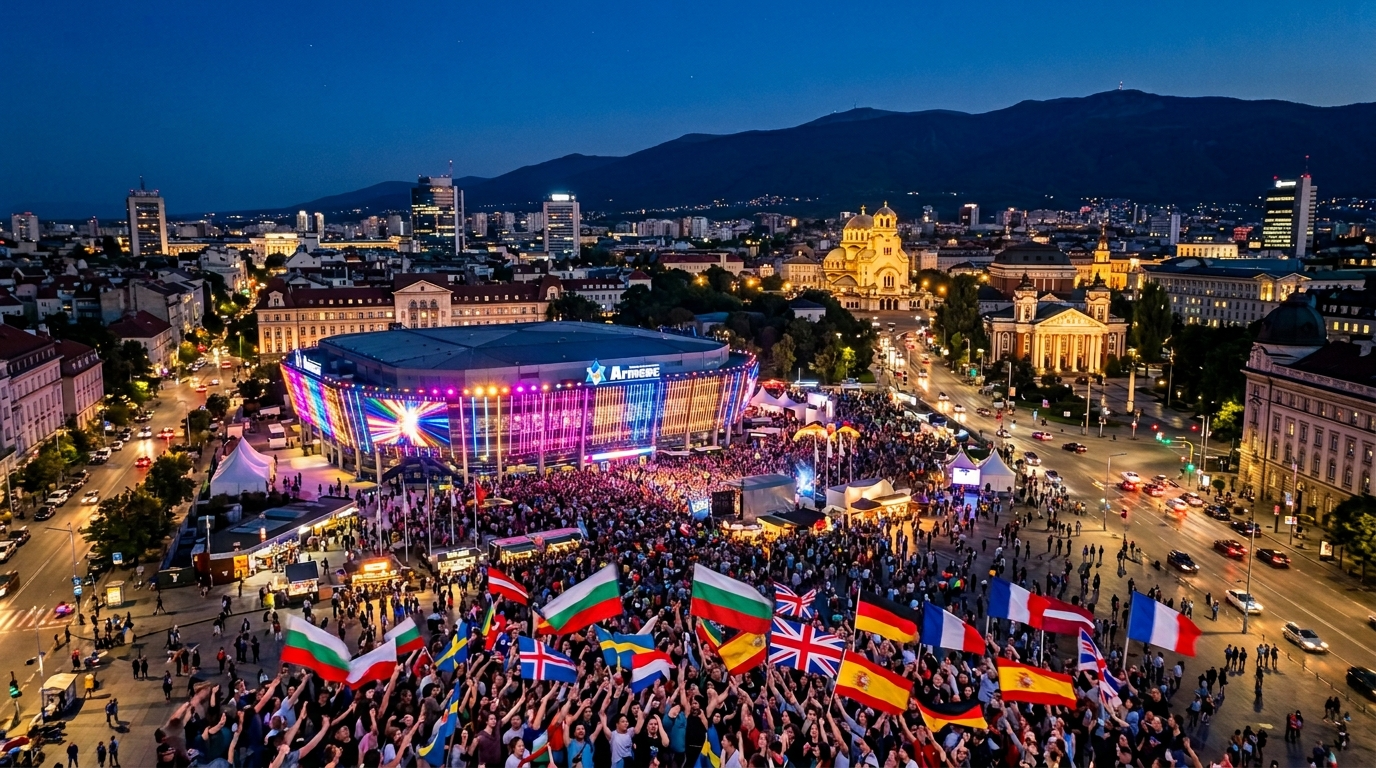
The capital city has Arena Armeec, a purpose-built indoor arena with around 12,373 seats expandable to nearly 18,000. That comfortably exceeds the EBU’s typical requirement of 8,000–10,000 spectator capacity once stage and production infrastructure is in place. Sofia also has Bulgaria’s main international airport, handling nearly 8 million passengers in 2024, with a direct metro connection to the city centre in around 30 minutes.
Hotel capacity? Over 22,000 beds across more than 1,700 accommodation providers. Public transport is solid, cheap and contactless. The nightlife around Vitosha Boulevard is genuinely good. And the city has the institutional infrastructure — media, security, logistics — to handle an event of this scale.
The weaknesses are real but manageable: Sofia is an inland capital with heavier traffic than the coastal cities, and it lacks the immediate “holiday resort” feel that somewhere like Varna or Burgas offers. Some fans may find it a slightly less picturesque backdrop than they’d hoped for. But no serious observer doubts that Sofia could host Eurovision without a hitch.
Verdict: The front-runner, and for good reason.
Varna
Varna is Bulgaria’s “sea capital” — a genuine coastal city with a huge seaside park, a lovely waterfront, beaches, and a relaxed summer energy that would look absolutely stunning as a Eurovision backdrop.
The problem is the arena. Varna’s Palace of Culture and Sports has a capacity of around 2,900–3,000 seats. That’s comfortably below the EBU’s minimum threshold. Without a major temporary construction project or a different venue solution, Varna faces a significant infrastructure challenge that may simply be too large to overcome in the available timeline.
That said, Varna has about 1.2 million visitors annually, strong international air links in summer, and the kind of coastal setting that makes for compelling television. If the EBU and Bulgarian organisers were willing to get creative — a purpose-built temporary arena, for instance — Varna could be spectacular. It’s just a much bigger ask.
Verdict: Beautiful city, difficult logistics. Dark horse at best.
Burgas
Burgas is the gateway to the southern Black Sea coast — Sunny Beach, Nessebar, Sozopol — and for that reason alone it will appeal to Eurovision fans who want to combine the contest with a proper beach holiday.
Unfortunately, Burgas has the same arena problem as Varna, only more so. There’s no large indoor venue even approaching Eurovision’s requirements. The city’s tourism infrastructure is also heavily seasonal, oriented around summer charter packages rather than May cultural events.
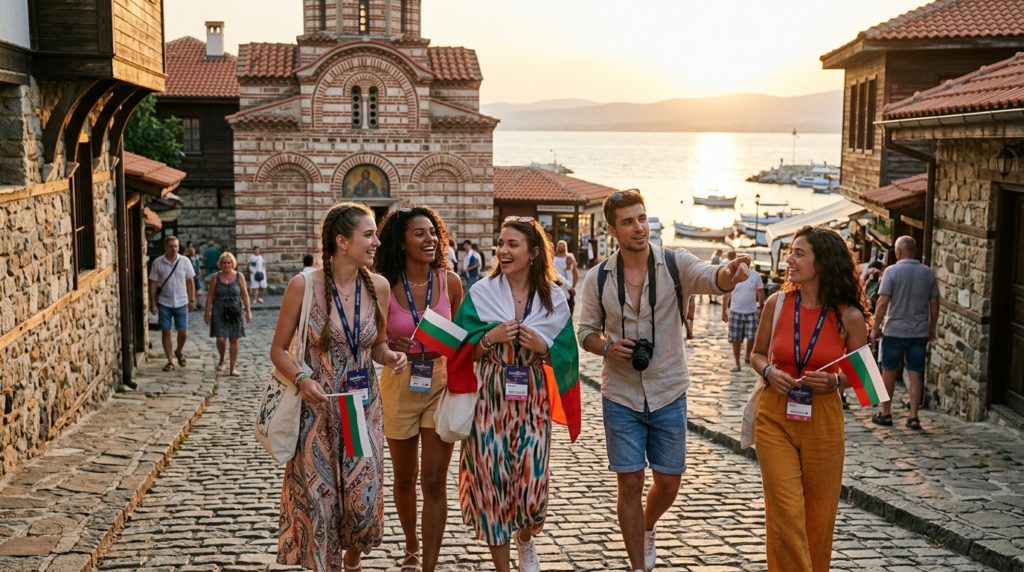
Where Burgas genuinely excels is as a base for the wider region. If Eurovision were held in Sofia, fans who want to extend their trip could absolutely spend a few days in the Burgas area — Sunny Beach is 20 minutes away, Nessebar is a UNESCO gem on the doorstep, and Sozopol is one of the most charming small towns on the entire coast.
Verdict: Not a realistic host city, but a brilliant holiday add-on.
Plovdiv
Plovdiv is arguably Bulgaria’s most interesting city from a cultural tourism perspective — one of Europe’s oldest continuously inhabited cities, European Capital of Culture in 2019, with a Roman theatre, Ottoman mosques, Bulgarian Revival architecture and a bohemian café district (the Kapana) that feels genuinely alive.
The arena situation here is better than Varna and Burgas but still tight. Kolodruma can hold between 4,800 and 7,500 people depending on configuration — approaching the lower end of Eurovision’s typical range. It might just work, particularly for a more intimate-style contest. Airport access is the real sticking point: Plovdiv’s airport is small, and most international fans would fly into Sofia and travel roughly two hours by bus.
Verdict: A wonderful city, but infrastructure makes it a long shot. Worth visiting regardless.
What Eurovision Fans Should Expect
Based on recent contests, Eurovision 2027 in Bulgaria will almost certainly take place in mid-May, with semi-finals on a Tuesday and Thursday and the grand final on Saturday. Vienna 2026 followed the now-standard format: Semi-Final 1 on 12 May, Semi-Final 2 on 14 May, Grand Final on 16 May. Bulgaria 2027 will likely mirror this.
The Eurovision Village — the free outdoor fan zone with big screens, live performances and food stalls — will probably occupy a central square or park in whichever city hosts. In Vienna it ran from 10–17 May. EuroClub, the official late-night party venue, typically runs the same period and requires a separate ticket.
For fans wanting the full experience — rehearsals, opening ceremony, EuroClub, the lot — plan for 7–10 days. If you’re just coming for the grand final weekend, three to four days in the host city plus a few days on the coast makes for an excellent itinerary.
Tickets are typically released in waves several months before the contest. Basel 2025 grand final tickets ranged from roughly 90–350 CHF. Bulgaria’s lower cost base may translate to slightly more accessible pricing, though EBU production costs are what they are. Book as soon as tickets drop — they go fast, every single year.
Travel Costs in Bulgaria: What to Budget
This is where Bulgaria genuinely stands out, and it’s worth being direct about it.
The cost of living in Bulgaria is roughly 53% lower than in the UK and around 58% lower than in the USA. That gap shows up everywhere: restaurants, transport, drinks, accommodation. A meal for two in a decent mid-range restaurant runs about 30–50 BGN (roughly £13–22). A beer at a bar will rarely set you back more than 3–5 BGN in most places.
Worth noting: Bulgaria joined the euro area on 1 January 2026, with the lev fixed at 1.95583 BGN to 1 EUR. By Eurovision 2027, the country will be fully on the euro, which simplifies things considerably for visitors from the eurozone. Contactless payments are widely accepted in cities, including on Sofia’s metro.
Party resort prices in Sunny Beach are legendarily low — cheaper drinks than almost anywhere in Europe. City prices in Sofia and Plovdiv are modest by any Western standard. Even with the price pressure that major events bring, Bulgaria is likely to remain one of the most affordable Eurovision trips in years.
The caveat: hotels in the host city during Eurovision week will price accordingly. Book early.
Best Airports and Getting Around Bulgaria
Sofia Airport (SOF) will be the main arrival point for most Eurovision visitors. It handled nearly 8 million passengers in 2024 and has a direct metro connection to the city centre — about 30 minutes, cheap, straightforward.
Burgas Airport (BOJ) is the best entry point for the southern Black Sea coast. Heavily used by UK, German and Polish charter passengers, it sits close to Sunny Beach and Nessebar. Saw 3% passenger growth in 2025 and has strong summer connectivity.
Varna Airport (VAR) serves the northern coast with around 1.9 million passengers annually and good links to Germany and Romania.
For getting between cities:
- Sofia to Plovdiv: Bus, around 2 hours, roughly €10–12. Easy.
- Sofia to Varna or Burgas: Train or bus, 6–7 hours. Overnight trains save a hotel night.
- Burgas to Nessebar or Sunny Beach: 20 minutes by bus or taxi.
Buses are generally more convenient than trains for most intercity routes. Taxis are affordable and widely available — just confirm the rough fare before you set off.
Where to Stay for Eurovision 2027
If Sofia is confirmed as host — and the indicators strongly suggest it will be — the best areas to stay are:
- City centre near Serdika or NDK metro stations: Walking distance to nightlife, restaurants and the metro line to the arena and airport.
- Vitosha Boulevard area: The main social strip, lined with bars, restaurants and shops. Lively and central.
- Near Arena Armeec: Practical for show days, quieter for everything else.
For fans wanting to combine Eurovision with beach time, the straightforward plan is: base in Sofia for the shows, then head to the coast. Burgas and the surrounding resorts are around 4–6 hours from Sofia by bus or train. Book coast accommodation early — summer season fills up.
A note on Sunny Beach specifically: it’s enormous, busy, and very lively. If your idea of a post-Eurovision wind-down involves cocktails on a beach at midnight, you’ll love it. If you’re after something quieter and more picturesque, Sozopol or Nessebar are both 30–40 minutes away and feel like a different world.
Bulgarian Food, Nightlife and Culture: What to Know
Bulgarian food is underrated. Full stop.
Shopska salad — tomatoes, cucumbers, peppers and grated white cheese — is the national dish in spirit if not official designation, and it’s one of those things that tastes better than it has any right to. Banitsa, a flaky cheese-and-egg pastry, is the breakfast of choice across the country. Kebapche (grilled spiced minced meat rolls) served with lyutenitsa (a tomato-pepper relish) and fresh bread is the kind of meal you’ll find yourself thinking about for months afterwards.
On the coast, fresh grilled fish and Black Sea seafood are the obvious choices. Bulgarian wine, produced mainly in Thrace and the Danube Plain, is genuinely good and extremely affordable.
For nightlife:
- Sofia has a proper club scene — electronic music institutions, rooftop bars, cocktail spots. Busy, varied, stays open late.
- Varna mixes Sea Garden bars with beachfront clubs in summer.
- Sunny Beach is full-on party resort energy: cheap drinks, beach clubs running until dawn, organised bar crawls. High energy, low pretension.
- Plovdiv’s Kapana district is the alternative option — artsy, intimate, wine-forward, with live music and a younger creative crowd.
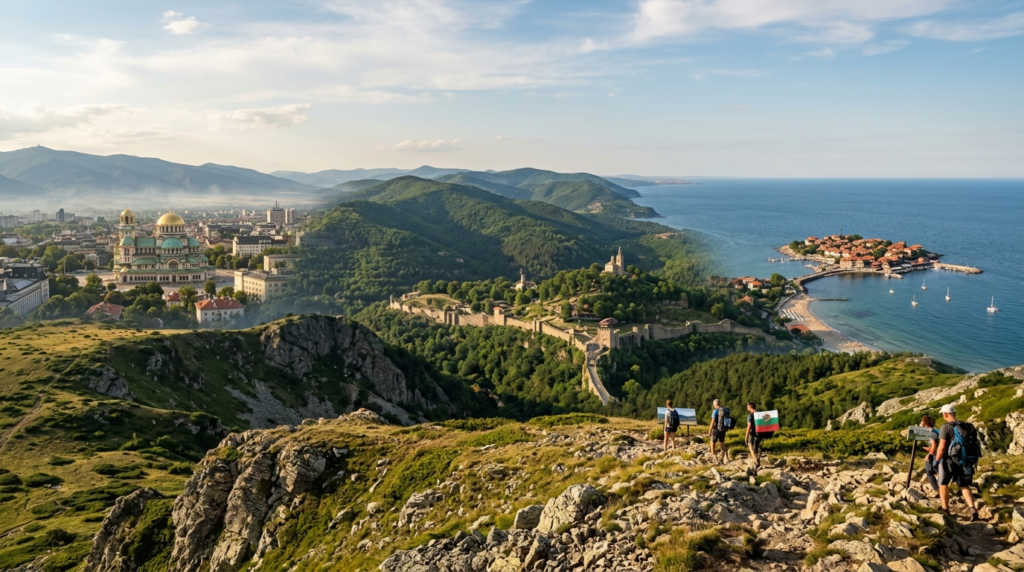
Culturally, Bulgaria rewards curiosity. Nessebar’s old town is a UNESCO World Heritage Site and genuinely extraordinary — 3,000 years of history on a tiny peninsula, 15 minutes from Sunny Beach. Plovdiv’s Roman Theatre hosts concerts and events against a backdrop that no architect could improve upon. Rila Monastery, about two hours from Sofia, is one of the most visually striking religious sites in all of Europe.
Eurovision fans who stay an extra week and explore properly will leave with a very different view of Bulgaria than they arrived with.
Is Bulgaria Safe for Tourists?
Yes, straightforwardly.
Bulgaria ranks around 28th globally on the Global Peace Index and 18th in Europe — ahead of Spain and Italy. Violent crime rates are low. Solo travellers, including women travelling alone, regularly describe feeling safe in major cities. The main precautions are the standard ones: watch your phone and wallet in crowded tourist areas, use registered taxis or ride-hailing apps, and be sensible about drinks in party resorts.
One famous local quirk worth knowing immediately: Bulgarians nod for “no” and shake their head for “yes” — the opposite of what Western Europeans expect. It creates some genuinely confusing moments until you adjust. Consider yourself warned.
English is widely spoken in tourist areas, hotels, restaurants and among younger people in cities. You’ll find it less common in rural areas and among older residents.
Why Bulgaria Could Genuinely Surprise Eurovision Fans
Here’s the honest pitch: Bulgaria is not the first country that springs to mind when Eurovision fans think about host nations. It doesn’t have the obvious glamour of a Paris or Stockholm, the party reputation of a Lisbon or Kyiv, or the sheer size of a Liverpool.
What it does have is extraordinary value, a stunning and underexplored coastline, historic towns that most of Europe hasn’t discovered yet, and a warmth and energy that tends to catch visitors off guard in the best possible way.
The fact that Eurovision 2027 coincides with Bulgaria’s Year of Cultural Tourism — and with the country’s first year in the euro area — makes this a genuinely interesting moment. The country is evolving, investing in infrastructure and image, and Eurovision is landing right in the middle of that transition.
Fans who arrive expecting cheap drinks and come away talking about medieval churches in Nessebar, grilled fish in Sozopol and the view from the Balkan Mountains at sunrise — that’s the story Bulgaria wants to tell. And based on everything the research suggests, it’s not an unrealistic one.
Final Thoughts
Eurovision 2027 in Bulgaria is shaping up to be one of the most affordable, accessible and genuinely surprising contests in recent years.
Sofia has the infrastructure to host it properly. The country has the coastline, history, food and nightlife to reward visitors who explore beyond the venue. And the story of DARA’s unlikely, late-surging, history-making victory in Vienna gives the whole thing a narrative that fans will want to be part of.
We’ll update this article the moment the host city is officially confirmed. In the meantime — start looking at flights, and maybe download a few Bulgarian phrases. You’ll need them.
Frequently Asked Questions
Where will Eurovision 2027 be held?
No official announcement has been made yet, but Sofia is the strong favourite based on arena capacity, airport infrastructure and comments from DARA herself following Bulgaria’s win at Eurovision 2026 in Vienna.
When is Eurovision 2027?
Based on recent contests, Eurovision 2027 will most likely take place in mid-May 2027, with semi-finals on a Tuesday and Thursday and the grand final on Saturday. Exact dates will be confirmed by the EBU once the host city is announced.
How much do Eurovision 2027 tickets cost?
Pricing hasn’t been announced. For reference, grand final tickets at Basel 2025 ranged from roughly 90–350 CHF. Bulgaria’s lower cost base may result in more accessible pricing, but EBU production requirements tend to set a floor regardless.
Do I need a visa to visit Bulgaria?
EU, EEA and UK citizens do not need a visa to visit Bulgaria. US and many other nationalities can enter visa-free for up to 90 days. Always check the latest requirements for your nationality before travelling.
What currency does Bulgaria use?
Bulgaria joined the euro area on 1 January 2026. By Eurovision 2027, the country will be fully operating on the euro.
Is Bulgaria expensive for tourists?
Bulgaria is one of the most affordable countries in the EU. The cost of living is roughly 53% lower than in the UK. Even accounting for price increases around major events, it’s likely to remain excellent value compared with recent Western European host cities.
Is Bulgaria safe for Eurovision fans?
Yes. Bulgaria ranks around 18th in Europe on the Global Peace Index. The main precautions are standard tourist awareness: watch your belongings in busy areas, use registered taxis, and be sensible about alcohol in resort areas.
Can I combine Eurovision with a beach holiday?
Absolutely. The Black Sea coast — Sunny Beach, Nessebar, Sozopol — is around 4–6 hours from Sofia. The coast comes alive in May, and combining Eurovision with a few days by the sea is one of the most appealing itinerary options available.
Do people speak English in Bulgaria?
English is widely spoken in tourist areas, hotels and restaurants, and among younger Bulgarians in cities. It’s less common in rural areas. Basic Bulgarian phrases will be appreciated but aren’t essential in major tourist destinations.
What’s the best airport to fly into for Eurovision 2027?
If Sofia is confirmed as host, fly into Sofia Airport (SOF) — Bulgaria’s main international hub with a direct metro link to the city centre. For a post-Eurovision beach trip, Burgas Airport (BOJ) is the most convenient for the southern Black Sea resorts.
Planning to combine Eurovision with a beach holiday? Sunny Beach complete guide · Things to do in Sunny Beach · Boat trips from Sunny Beach