

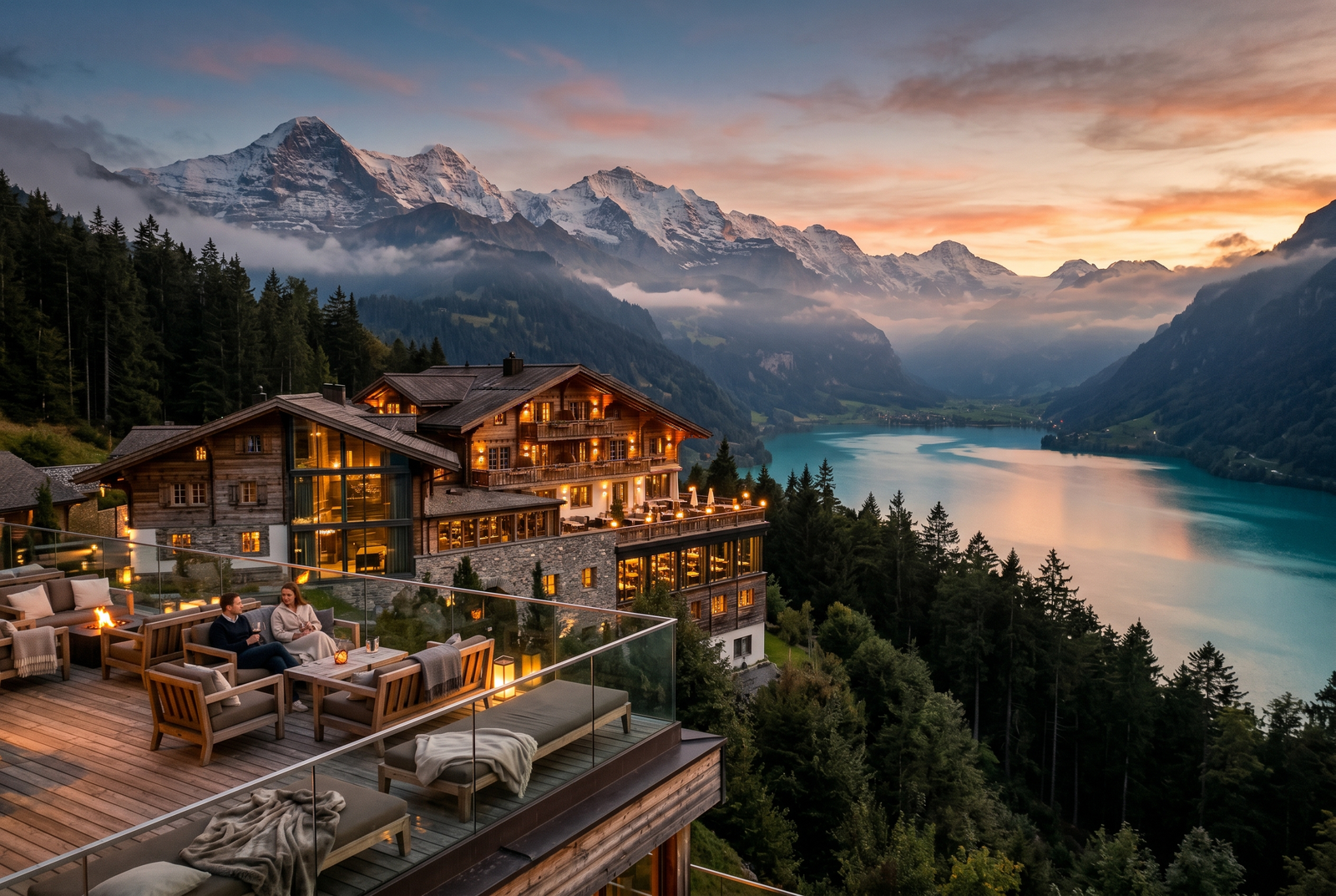

The first thing Switzerland does is lower your voice.
Your 3 days in Switzerland by train will be filled with unforgettable moments and picturesque scenery.
It happens almost immediately after landing at Zurich Airport. The clean signage. The people moving with purpose but without hurry. A coffee from the terminal café that has no business tasting as good as it does. You collect your bag, follow the signs downstairs, and somehow — without really trying — you’re already on a train heading into the country.
For a UK traveller, Zurich Airport is one of the rare arrivals that feels less like a transfer and more like the opening scene of the trip itself. The mountains are still hidden. But something has already shifted.
Staying Connected in Switzerland
One thing I underestimated before my first Switzerland train trip was how often I relied on mobile data.
Train platforms change quickly, Google Maps becomes part of the journey, and checking weather in the mountains matters more than expected.
Using an eSIM before landing in Zurich makes the entire arrival feel smoother — especially if you’re travelling from the UK and want instant connection without searching for local SIM cards at the airport.
This is a 3-day itinerary built around Switzerland’s rail network — from Zurich Airport through Lucerne and on to Interlaken and Lauterbrunnen. It’s designed for first-time visitors who want the romance without the logistics turning into a chore. Scenic trains, lake evenings, the big alpine reveal, a few genuinely good meals, and enough time to stop and actually notice where you are.
The journey of 3 days in Switzerland by train is as much about the travel experience as it is about the destinations.
“The best way to see Switzerland is slowly, by train, with no fixed plan for what to admire next.”
Quick Overview: What to Expect from 3 Days in Switzerland by Train
3 days in Switzerland by train is perfect for those wanting to relax and soak in the sights.
With no car needed, travelling 3 days in Switzerland by train is easy and enjoyable.
| Day | Route | Highlight |
| Day 1 | Zurich Airport → Lucerne | Lakefront arrival, old town evening |
| Day 2 | Lucerne → Interlaken + Lauterbrunnen | Scenic train journey, alpine views |
| Day 3 | Lauterbrunnen → Lucerne → Zurich | Quiet valley morning, return through the lakes |
Primary transport: Swiss Federal Railways (SBB) + Zentralbahn scenic route
Best season: Late May to June or September to early October
Good for: First-time visitors, couples, solo travellers and UK travellers on a short break
Car needed? No. The trains do everything.
Covers all three legs of this journey from day one and removes the stress of buying separate train tickets.
Day 1: Zurich Airport to Lucerne
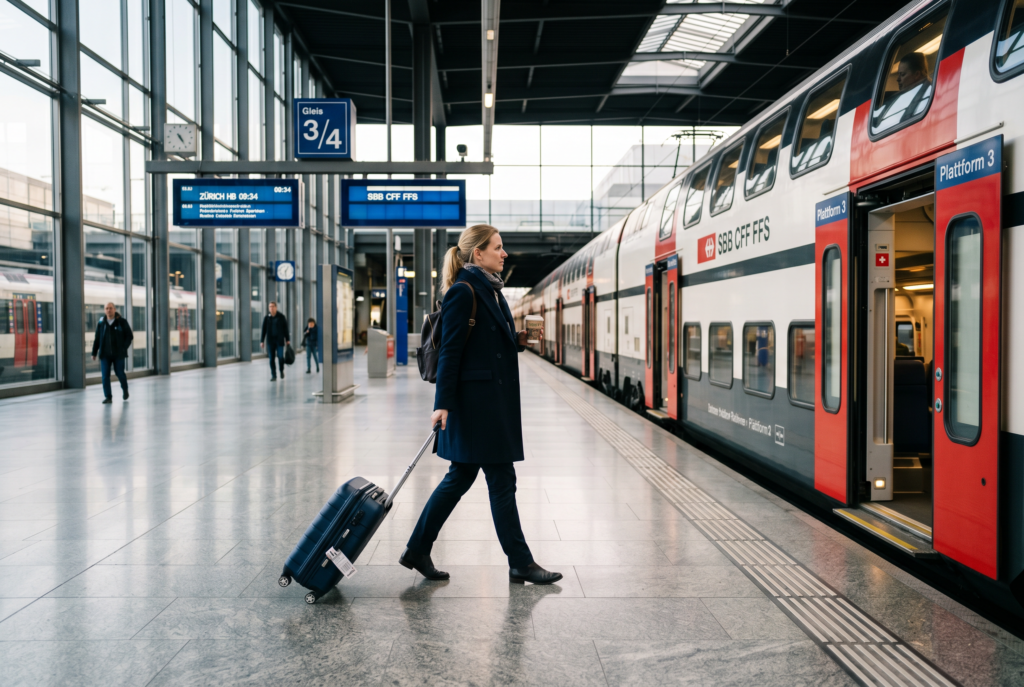
There’s something satisfying about arriving in a country and immediately moving through it. No hotel lobby to queue in, no taxi negotiation. Just wheels on tracks and the scenery starting to change outside the window.
The direct train from Zurich Airport to Lucerne runs frequently and takes around an hour. Tidy suburbs give way to open fields, and then — almost without announcement — you’re in lake country. By the time you pull into Lucerne station, the pace of the whole trip has already changed.
Step outside and the city is right there. The old town is close enough to reach on foot, and that matters on day one when you’re tired and carrying more luggage than you planned to. The lake sits at the end of every straight road. The Chapel Bridge shows up in about forty photographs before you’ve even checked in.
Where to Stay in Lucerne
For a short trip, location matters more than room size. There are three areas worth considering:
- Near Lucerne station — the most convenient option for early morning departures
- Old town — the most atmospheric, with cobblestones, shuttered windows and the sound of the river below
- Lakefront — the most cinematic choice, especially if the budget allows
The journey of 3 days in Switzerland by train offers breathtaking views at every turn.
After a day of adventures, unwind from your 3 days in Switzerland by train with some local delicacies.
For a first-time visit, the station-to-old-town corridor is the practical sweet spot. You can drop your bag, open the window, and hear the city before dinner without needing to go anywhere in particular.
For this itinerary, staying close to the station makes the next morning significantly easier.
What to Eat on Night One
Keep it simple. Rösti, melted cheese dishes, or Älplermagronen if the menu offers it. Swiss food on a first night should feel comforting rather than challenging.
If there’s a bakery near your hotel, buy something for the morning train while you’re there — a croissant, a cheese pastry, anything that makes breakfast feel like part of the journey rather than a separate task.
I spent slightly too much money on coffee in Switzerland and never really regretted it.
A Quieter Side of Lucerne
The famous bridge is genuinely worth seeing. But the part of Lucerne I keep returning to in my memory is not that.
It’s the quieter edge of the promenade, where the lake opens out and the city stops performing for the camera. A cyclist ringing past. A waitress setting down tap water before you’ve asked. Church bells after sunset, softer than expected.
Tourists cluster where the photographs already exist. The rest of Lucerne is just there, waiting.
“There’s a version of Lucerne that never makes it into travel brochures. That’s the one worth looking for.”
Day 2: Lucerne to Interlaken on the Luzern–Interlaken Express
Day two is the one to build the whole itinerary around.
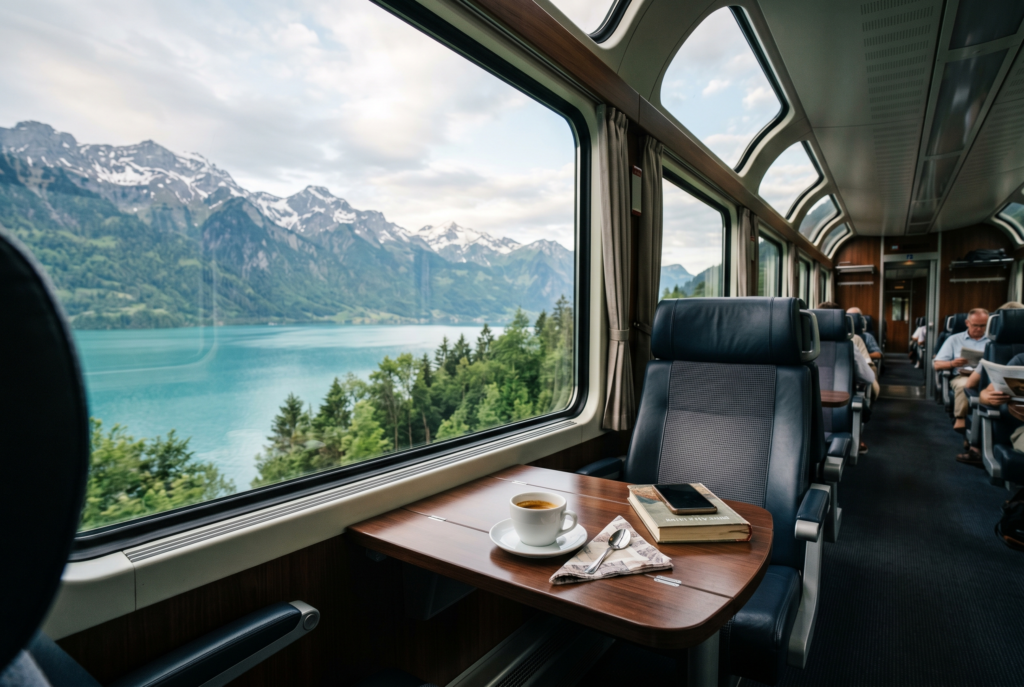
Wake early. Check the weather before anything else — in Switzerland, weather is not background information, it’s part of the story. Grab a coffee and something from a bakery, then head to the station for the Luzern–Interlaken Express, one of the most quietly spectacular train journeys in Europe.
The route runs hourly and passes through lakes, waterfalls, mountain passes and alpine villages that never feel repetitive. The landscape keeps introducing itself in new ways: flat-calm water, then narrow gorge, then open meadow, then a village so small you’re not sure it has a name.
What the Journey Actually Feels Like
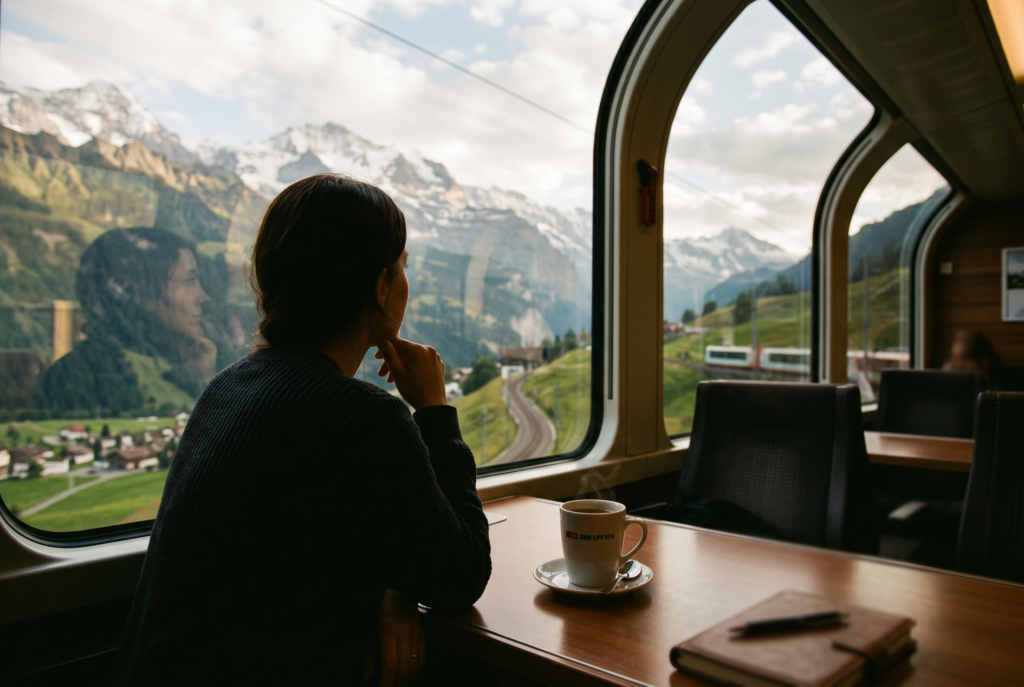
There’s a particular kind of silence on Swiss scenic trains. Not awkward — meditative, almost.
A couple across the aisle sharing one pair of headphones. Someone opening a chocolate bar with surprising delicacy. A lone traveller taking photos every few minutes, then eventually stopping because they’ve realised no image fully explains what it feels like to sit inside this landscape.
At one point I realised the entire carriage had gone silent except for the sound of someone carefully opening a packet of crisps.
The windows are large. The seats are comfortable. The whole thing moves at exactly the right pace.
Seat reservations are recommended, especially in summer or on weekends. The fee is relatively small and absolutely worth it for this route.
One of the easiest ways to experience Switzerland’s alpine scenery without needing a car.
The Switzerland Scenic Train Itinerary: What You’ll See
The route covers scenery that would take half a day to drive and far less of it would actually be visible from the road.
The landscape changes constantly, but without ever feeling dramatic for the sake of it. Switzerland somehow manages to feel cinematic and calm at the same time.
- Lake Sempach and Lake Sarnen — calm, glass-like water and small lakeside villages
- Brünig Pass — the train climbs gradually and the views widen with it
- Lake Brienz — the kind of blue-green colour that barely looks real in photographs
- Brienz to Interlaken — where the mountains finally begin to dominate the horizon
Interlaken or Lauterbrunnen: Where to Sleep?
This is the question most first-time visitors get stuck on, and honestly, the answer depends on what you value more.
Interlaken is the practical choice. It’s well connected, easy to navigate and gives you more restaurant and hotel options.
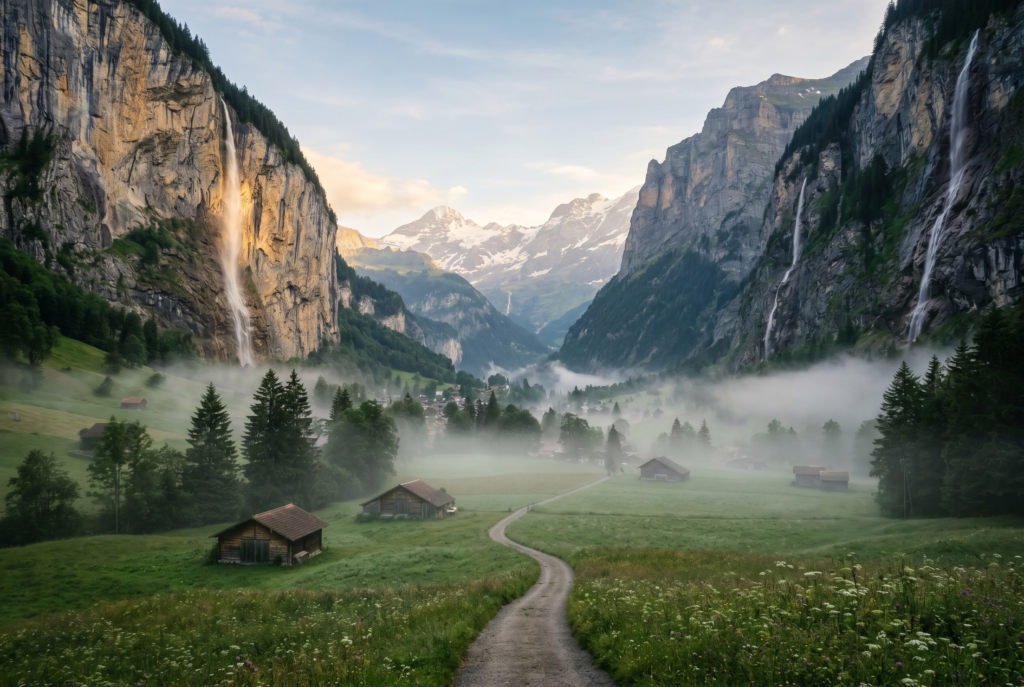
Lauterbrunnen is the emotional choice. The valley closes around you, the waterfalls feel closer at night, and the early morning atmosphere is something you’ll struggle to explain properly to people back home.
My personal recommendation is to stay in Interlaken and spend the afternoon and evening in Lauterbrunnen.
The train between them is direct and takes around 20 minutes, which means you get the atmosphere without sacrificing convenience.
Book early if travelling between June and September — the best locations disappear fast.
What to Eat in the Interlaken Region
After a scenic train day, alpine comfort food is exactly what makes sense.
Raclette, rösti, soup with fresh bread, or something warm eaten beside the lake while the evening light starts disappearing behind the mountains.
Some of the best food moments in Switzerland are less about the restaurant itself and more about where you happen to be sitting when you eat.
If the weather is good, take something simple and eat outside instead of rushing into another indoor table.
“The Luzern–Interlaken Express earns its reputation about forty minutes in, when you stop trying to photograph the view and just sit with it.”
Day 3: Lauterbrunnen at Dawn, Then the Long Way Home
The final morning should start quietly, and Lauterbrunnen rewards that instinct.
End your trip with cherished memories from your 3 days in Switzerland by train.
Get there early — before the first coaches and day-trippers arrive. The valley feels completely different when it’s still half asleep. The waterfalls sound louder because there is less else happening around them. The cliffs catch the first light slowly, and for a moment the whole place feels less like a destination and more like the beginning of a memory.
If you stayed in Interlaken, the train to Lauterbrunnen takes around 20 minutes. If you stayed in Lauterbrunnen overnight, even better — you’ve already won the quietest hours of the day.
Spend the morning slowly. Walk farther than the obvious viewpoint. Buy coffee from somewhere small. Stand still for a few minutes instead of trying to optimise every second of the itinerary.
Switzerland works best when you stop treating it like a checklist.
My Favourite Unbusy Moments on Day Three
Small things stay with you more than expected.
Standing under a drip of meltwater from a roof edge. A station café worker recognising you after one visit and nodding. A family in hiking boots quietly arguing over the correct platform.
None of it appears on anybody’s “Top 10 Switzerland Experiences” list.
All of it somehow becomes the trip.
If your flight is later in the evening, route back through Lucerne and spend one final hour by the lake before heading to Zurich Airport.
That last train ride feels like the closing scene of the journey — mountains giving way to smaller towns, lakes flattening into reflections, the country slowly easing you back toward the airport without ever feeling abrupt.
A perfect ending awaits on your last evening of 3 days in Switzerland by train.
Useful if you prefer a simple airport arrival or departure after a long flight.
Scenic Train Section: The Luzern–Interlaken Express, Explained
The Luzern–Interlaken Express is the kind of train journey that makes you question why so much European travel still revolves around airports and motorways.
It isn’t a tourist gimmick. It’s a real regional route that just happens to pass through some of the most accessible alpine scenery in Europe.
The trains run frequently, the connections are reliable, and the experience feels surprisingly relaxed considering how much scenery is packed into less than two hours.
- Duration: approximately 1 hour 50 minutes
- Frequency: hourly departures
- Reservation: recommended in peak season
- Covered by the Swiss Travel Pass
- Main highlights: five lakes, Brünig Pass and alpine waterfalls
The best seats are usually on the right side when travelling from Lucerne to Interlaken, especially along Lake Brienz.
But honestly, both sides of the train have moments that make people stop talking for a while.
A simple option if you want flexible train travel without constantly buying separate tickets.
Hotel Recommendations for This Switzerland by Train Route
For a short Switzerland itinerary like this, hotel location matters more than almost anything else.
Being close to the station, the lake, or the route itself changes the entire rhythm of the trip — especially when you’re moving between destinations by train.
Hotels in Lucerne
Look for hotels near Lucerne station or along the lakefront promenade.
For a first-time visit, the station area is the best balance between atmosphere and practicality. You can walk into the old town within minutes and still make early morning trains without dragging luggage across half the city.
Hotels in Interlaken
Interlaken works best as a flexible base for this itinerary.
Hotels near Interlaken Ost station are ideal if you’re planning to continue toward Lauterbrunnen or other mountain routes the next morning. The west side of town is slightly quieter and often feels less tourist-heavy in the evenings.
Staying in Lauterbrunnen
Accommodation inside Lauterbrunnen itself is more limited, which is part of the appeal.
Smaller guesthouses and valley-floor hotels tend to book out quickly during summer, especially those with waterfall or mountain views. If staying in the valley is important to you, this should be the first part of the itinerary you reserve.
Budget Guide: How Much Does 3 Days in Switzerland Cost?
Switzerland is not a budget destination, and honestly, trying to force it into one usually makes the experience worse.
The good news is that the costs are predictable. Once your transport is covered, the main variable becomes accommodation and how many mountain excursions you decide to add.
| Expense | Estimated Cost (per person) |
| Swiss Travel Pass (3-day) | £220–£260 |
| Mid-range hotels | £150–£260 per night |
| Food & drinks | £50–£90 per day |
| Scenic train reservations | £10–£30 |
| eSIM | £8–£15 |
| Airport transfers (optional) | £20–£50 |
| Estimated total: £700–£1,100 |
The Swiss Travel Pass usually earns its value on a route like this because it covers the airport train, the Luzern–Interlaken Express, regional trains and local transport without needing separate tickets.
More importantly, it removes a surprising amount of mental effort during the trip itself.
If that total feels like a lot, a similar mountain trip — including the skiing — costs far less in Bulgaria. My Bulgaria ski resorts guide breaks down what to expect.
FAQ: Switzerland by Train for First-Time Visitors
Is 3 days enough for Switzerland by train?
Yes — if you keep the route focused.
Lucerne, Interlaken and Lauterbrunnen give you a realistic first impression of Switzerland without turning the trip into constant moving and repacking.
Do I need a car for this Switzerland itinerary?
No. For this route, the train network is the experience itself.
Zurich Airport connects directly to Lucerne, the Luzern–Interlaken Express handles the scenic section, and Lauterbrunnen is easily reached by regional train.
Is the Luzern–Interlaken Express worth it?
Absolutely.
It combines alpine scenery, lakes, waterfalls and practical point-to-point travel in under two hours, which makes it one of the easiest scenic train experiences in Switzerland for first-time visitors.
Should I stay in Interlaken or Lauterbrunnen?
Interlaken is the easier and more flexible base.
Lauterbrunnen is more atmospheric and visually dramatic.
For most first-time visitors, staying in Interlaken and spending more time exploring Lauterbrunnen gives the best balance.
Is the Swiss Travel Pass worth buying?
For this specific itinerary, yes.
It covers the main train journeys, simplifies connections and removes the need to buy separate tickets throughout the trip.
Final Thoughts: Why This Route Works
Three days in Switzerland feels like it should be too short.
Somehow, on this route, it isn’t.
Zurich Airport is one of the smoothest arrivals in Europe. Lucerne earns its reputation without trying too hard. The Luzern–Interlaken Express genuinely deserves the attention it gets. And Lauterbrunnen, early in the morning before the crowds arrive, is the kind of place that quietly stays with you long after the trip ends.
This itinerary works because the trains are part of the experience rather than simply the transport between destinations.
You don’t spend the trip fighting logistics. You spend it looking out of windows, walking beside lakes, hearing church bells across the water and occasionally forgetting to check your phone for a while.
Come back with more time.
For a first trip to Switzerland, this is enough.
“Switzerland doesn’t need you to rush. That’s the whole point.”
Ready to Plan This Switzerland Train Trip?
- Swiss Travel Pass — covers every major train on this route
- Hotels in Lucerne — best near the station or lakefront
- Hotels in Interlaken — ideal for Lauterbrunnen connections
- Switzerland eSIM — useful immediately after landing
- Zurich Airport Transfer — optional, but convenient after long flights
Related Switzerland Travel Guides
- Switzerland vs Austria: Which Is Better for a First Trip?
- The Glacier Express vs the Luzern–Interlaken Express
- 5 Days in Switzerland: Extended Scenic Train Route
- Best Swiss Travel Pass Options Explained
- Switzerland Budget Guide for UK Travellers
Don’t forget the stunning views while travelling 3 days in Switzerland by train.
Ensure you take your time during your 3 days in Switzerland by train to fully appreciate the landscapes.
Nothing compares to the experience of 3 days in Switzerland by train, filled with unforgettable memories.
Plan your 3 days in Switzerland by train with these insights for a memorable trip.
Read next: Where to Stay in Switzerland, Luzern–Interlaken Express Guide